Single vs Multi-Agent Systems: The Real Trade-offs Behind the Hype
Everyone in the tech world right now is talking about agentic systems. Founders want it. Product teams are planning roadmaps around it. Engineers are debating…
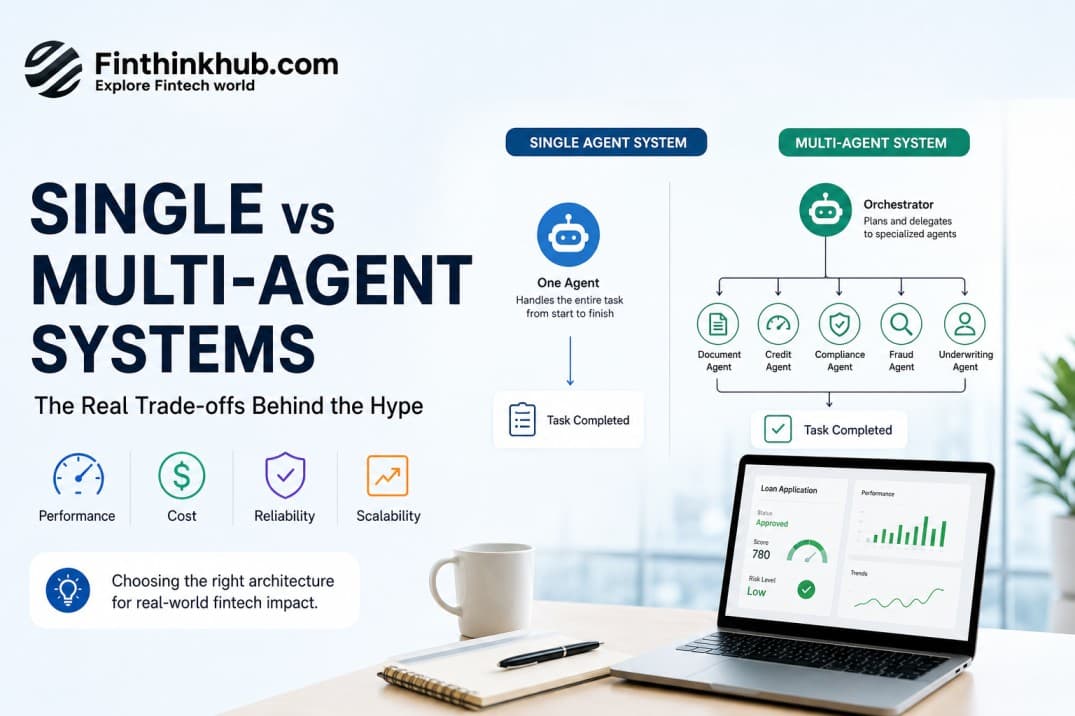
Everyone in the tech world right now is talking about agentic systems. Founders want it. Product teams are planning roadmaps around it. Engineers are debating frameworks on every Slack group you can find.
But here is what nobody is saying out loud. More agents does not always mean better results. Sometimes it just means more cost and more things that can break.
So before you go and architect a 6-agent pipeline for your fintech product, let's actually talk through what matters here.
How Did We Even Get Here
Not long ago most teams were just sending a prompt and getting a response back. That was the whole workflow. You type something in, the model gives you an answer, done.
Then slowly things started getting more interesting. People began chaining those calls together. One model's output would go into the next step. Then memory got added. Then tools like web search or database access. Then the model started deciding on its own what step to take next.
That is basically what an agent is. A model that thinks through a task, picks up the right tools, takes actions, and keeps going until the job is done. It is not just answering questions anymore.
Now the real question teams are dealing with is not whether to use agents. It is how many agents you actually need and for what purpose.
What is a Single Agent System
One model. One thinking loop. One place where everything happens.
You give it a task. It figures out the steps on its own. It uses whatever tools it has access to. It finishes the job and gives you the output.
Think of it like a really capable person working alone. They have a calculator. They have access to a database. They can search things. They get the work done without needing to check with anyone else.
In a fintech product this could be a loan screening assistant that collects a few details from a user, pulls credit data from a bureau and gives back an eligibility result in seconds. Or a support bot that looks up a customer's transaction history and resolves their query without escalating. One system. One flow.
Fast to build. Cheap to run. And when something goes wrong you know exactly where to look.
What is a Multi Agent System
Now picture a small team instead of one person.
You have a document specialist. A credit analyst. A compliance reviewer. A fraud investigator. An underwriting officer. Each person does their specific job and hands off to the next.
That is a multi agent system. Multiple models each playing a defined role in a workflow. There is usually one orchestrator sitting on top that decides who does what and in what order.
Here is how a real loan origination flow looks when it is broken across agents:

Each agent has one job. The orchestrator keeps the pipeline moving. Nobody is doing two jobs at once.
Comparing the Two Side by Side
Let us stop being abstract and just look at the numbers and facts.
What You Care About Single Agent Multi Agent Complexity to build Low High Cost per task Lower Higher Speed Faster Slower Scalability Context window is the limit Can run tasks in parallel Debugging Simple Complicated Output quality for complex tasks Moderate Better
Here is one number worth keeping in mind. A 4-agent setup running a 5-round process requires at least 20 model calls to finish. That is cost stacking up on every single transaction.
Google Research studied this closely and found that for tasks requiring sequential reasoning multi-agent systems actually performed 39 to 70 percent worse than a single well-designed agent. So throwing more agents at a problem does not fix it.
When Single Agent is the Right Choice
Most early stage products honestly do not need the complexity of multiple agents.
Single agent is a good fit when your workflow is mostly step by step rather than truly parallel. When you are watching your infrastructure costs closely. When the task can be handled within one thinking session without needing separate specialist roles. When your team is small and does not have time to manage a full orchestration setup.
If you are building a chatbot or a document processing tool or a simple eligibility checker then single agent is the right starting point. There is no need to overcomplicate it at this stage.
When Multiple Agents Start Making Sense
There are situations where one agent genuinely cannot do the job well. Fintech is full of them.
Take lending as an example. A full loan origination process involves document verification, credit risk scoring, fraud screening, regulatory compliance checking and underwriting. These are completely different domains with different logic and different rules. Splitting them across specialist agents actually makes the output more accurate. It also makes it much easier to audit later if a regulator asks questions.
For fraud detection the case is even clearer. We are talking about hundreds of thousands of alerts coming in every single day. A human analyst might take 30 to 90 minutes to clear one alert. An agent setup can process the same alert in seconds and with higher accuracy. You simply cannot do that with a single sequential system.
Regulatory compliance is another area where separation matters. When you need to show a regulator exactly what logic ran at each step a multi agent setup gives you that clean audit trail. One agent did the compliance check. Another did the fraud check. The reasoning did not mix.
Payment validation works the same way. High volume flows where different rules apply at each stage are a natural fit for parallel agents.
The Problems That Come With Multiple Agents
Now the part that does not get talked about enough.
Running multiple agents is genuinely hard to operate at scale.
Getting the orchestration right takes real engineering effort. You have to figure out which agent runs first, how they hand off information to each other and what happens when one of them fails halfway through a workflow.
Errors do not stay contained. If the first agent in your pipeline gives back a wrong output then every agent after it is working off bad information. The mistake compounds quietly and by the time you catch it the damage is done. In lending or payments that is a serious problem.
Cost adds up faster than people expect. Six agents running on ten thousand transactions a day is a lot of model calls. Teams often only realize this when the infrastructure bill arrives.
Speed takes a hit too. What looks like a smooth pipeline on a whiteboard can turn into a 25 to 30 second wait time in production. That kind of latency is noticeable to users and hard to explain.
The Hybrid Setup Is Where Most Teams Are Heading
Here is the practical approach that thoughtful engineering teams are landing on right now.
One main orchestrator agent handles most of the work. It manages the flow, uses tools, tracks context. But when it hits something that genuinely needs a specialist it calls one. Otherwise it keeps going on its own.
For a lending product this could look like: the main agent handles document extraction, eligibility checks and credit data. It only calls a compliance agent on every application because regulation requires it. It only calls a fraud specialist when it spots something suspicious. Everything else stays in one place.
You get the speed and cost benefits of a single agent for the bulk of the work. You get specialist quality when the task actually demands it. You are not running 6 agents on every transaction just because you can.
Most production fintech systems will likely settle into this pattern over the next year or two.
A Real Fintech Flow With the Hybrid Approach
Here is what that hybrid lending pipeline actually looks like in practice:
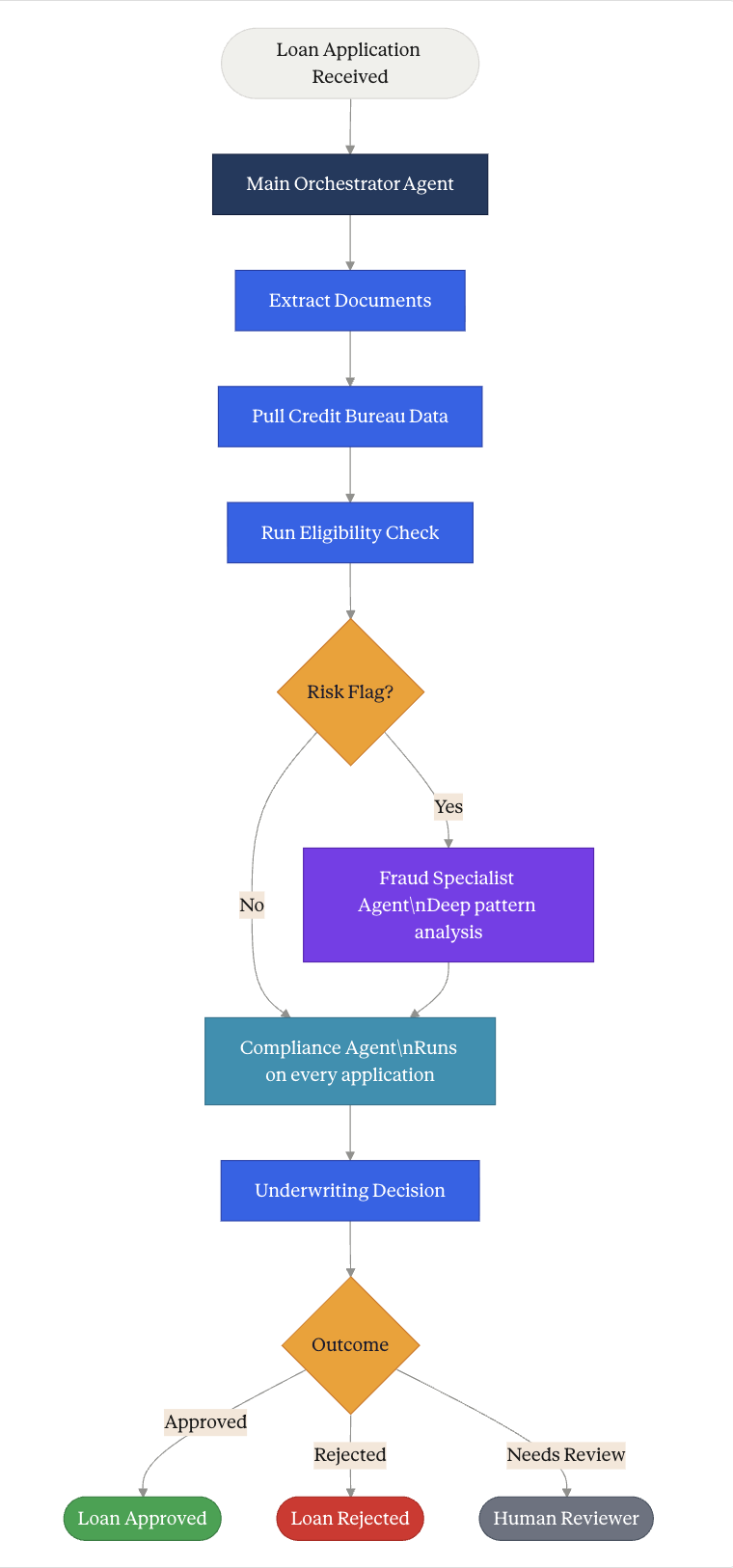
Compliance runs on every case. Fraud analysis only kicks in when something looks off. The orchestrator handles the rest. This keeps the pipeline fast and affordable while still meeting the quality bar.
Where This Leaves You
Multi agent systems are not better by default. They are a trade-off between handling complex structured work and managing real engineering and operational overhead.
If your problem is simple, start with one agent. If your problem genuinely needs parallel reasoning or specialist separation then multiple agents make sense. If you are somewhere in the middle, which most fintech products are, the hybrid approach is your best bet.
The mistake most teams make is building more complexity than the current problem actually requires. Start with the simplest thing that works. Add agents when the problem forces you to, not because the architecture looks impressive in a diagram.
Finthinkhub.com covers practical thinking at the intersection of fintech, product and engineering.
Key Takeaways for Quick Readers
Single agent systems are fast, cheap and easy to manage. Multi agent systems are better for complex workflows that need domain separation but they cost more and take longer to build. In fintech the clearest use cases for multiple agents are lending, fraud detection, compliance and payment validation. Most production teams are moving toward a hybrid model where one orchestrator does the heavy lifting and specialist agents are called only when needed. More agents does not mean better output. Stanford and Google research both confirmed this.
Published on Finthinkhub.com
Responses (0)
Leave a response
Related Articles

GuideFin: A Real Plan Not Just Another Investment App
Why the middle class Indian investor doesn't need another place to invest. They need a clear plan, and an honest way to …
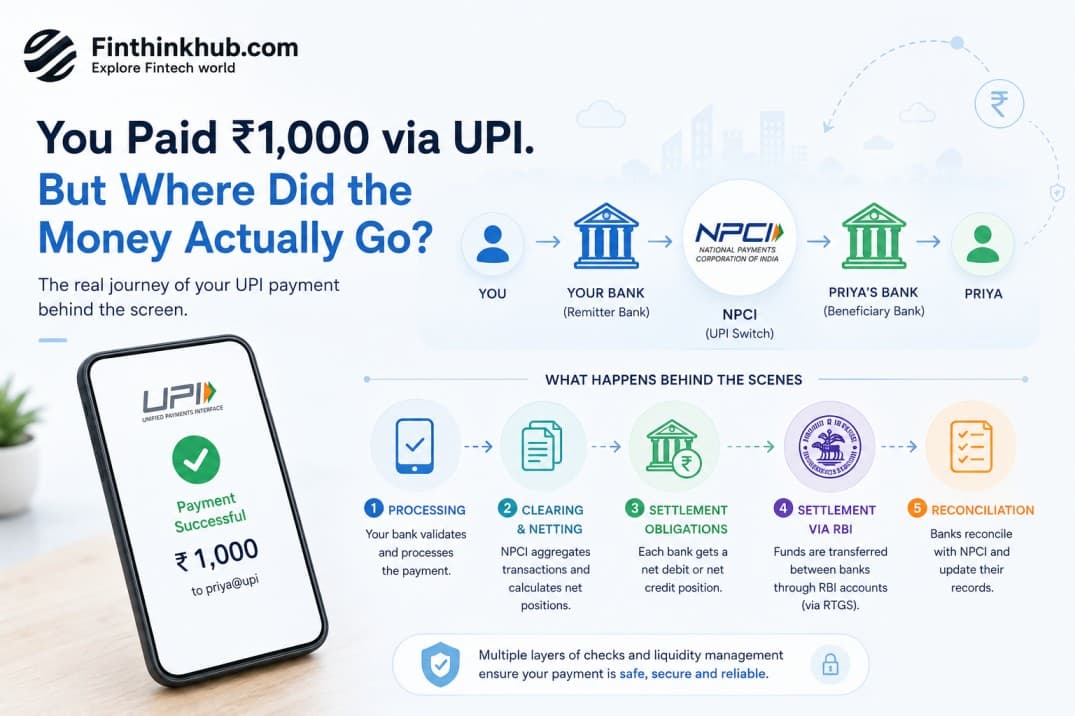
What Happens When You Send Money on UPI: A Complete Breakdown
You send ₹1,000 to Tarun who is your colleague in Noida on UPI. Your phone buzzes, the app shows a green tick, "Payment …

How Invoice Discounting Apps Are Growing in India
Most Indians learn investing in the same order: 1st savings account, then FD, then mutual funds and SIPs, then maybe NPS…