Why a 5% Bond Yield in America Is Shaking Your Portfolio in India
Open your mutual fund app this month and you will probably see in red. The Nifty has fallen for seven weeks in a row, and the rupee is near 96 to a dollar. A…

Open your mutual fund app this month and you will probably see in red. The Nifty has fallen for seven weeks in a row, and the rupee is near 96 to a dollar.
A big part of the answer sits in Washington. It's the US 10-year bond yield, which crossed 5% in September 2026 for the first time since 2007. The other part sits in New Delhi our own tax rules. Let's understand.
First, what is a bond yield?
A bond is simply an IOU. You lend the US government $100, and it pays you interest every year and returns your money later. The yield is the return you earn. If a 10-year US bond pays 5% a year, its yield is 5%.
US government bonds are seen as among the safest investments in the world. So this yield becomes the world's "base rate." Every other investment, including Indian shares, gets compared against it.
Think of it like a fixed deposit. If your bank FD suddenly paid 9%, would you still risk buying a small-cap stock? The same thinking plays out globally.
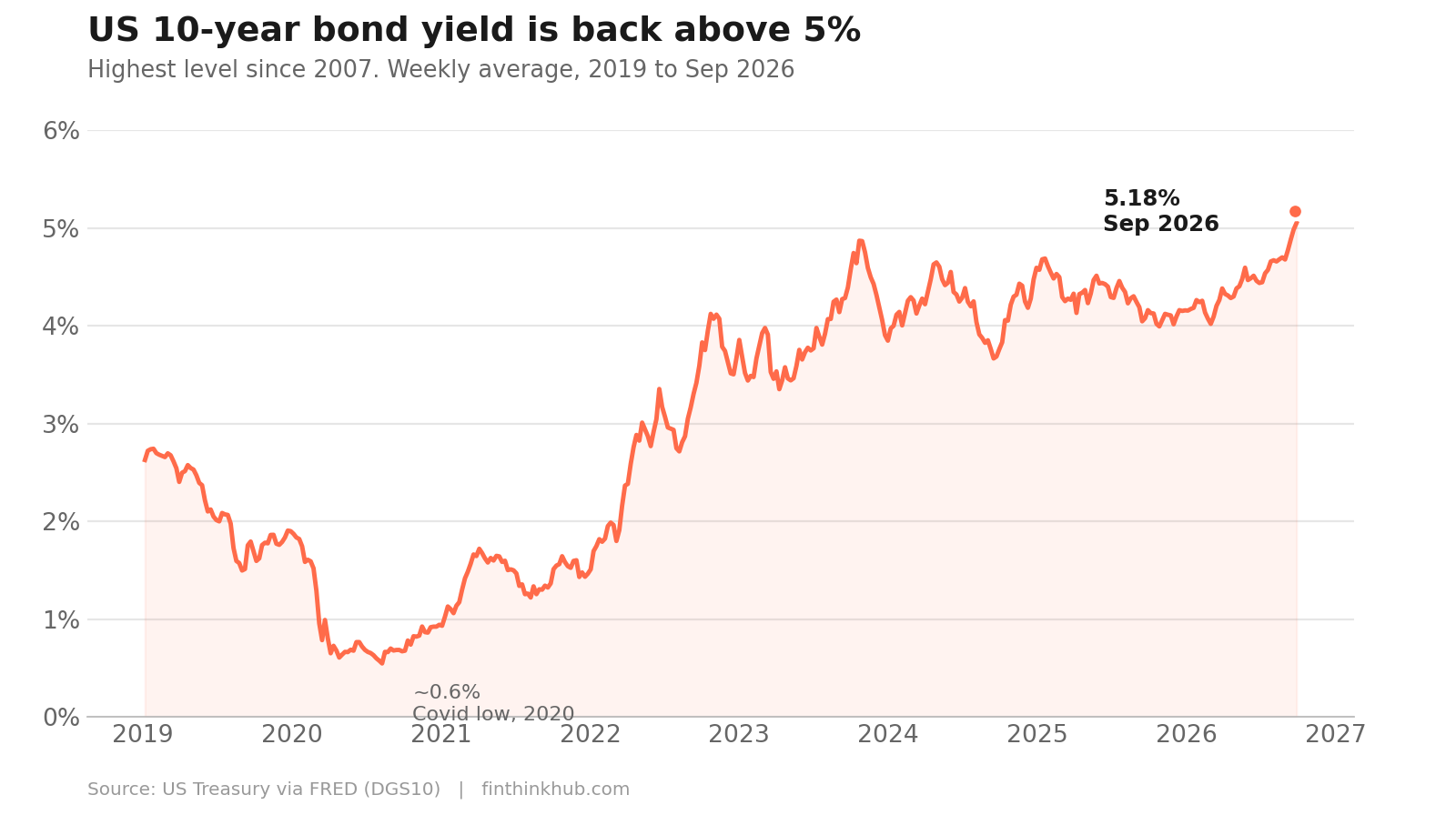
In 2020, this yield was around 0.6%, and cheap money flooded into India. Today it's above 5.1%.
Why are US yields rising now?
Sticky inflation. Brent crude is above $100 because of the US-Iran conflict, so investors want more interest to beat inflation.
The Fed may hike again. The US Federal Reserve's rate is at 3.75% to 4.00%. Markets now see a strong chance of another hike instead of a cut.
Too much US government debt. When a borrower keeps asking for more loans, lenders ask for a higher rate.
Fewer big buyers. Countries like Japan, which used to buy huge amounts of US bonds, now get better returns at home.
How does a US number reach your Indian portfolio?
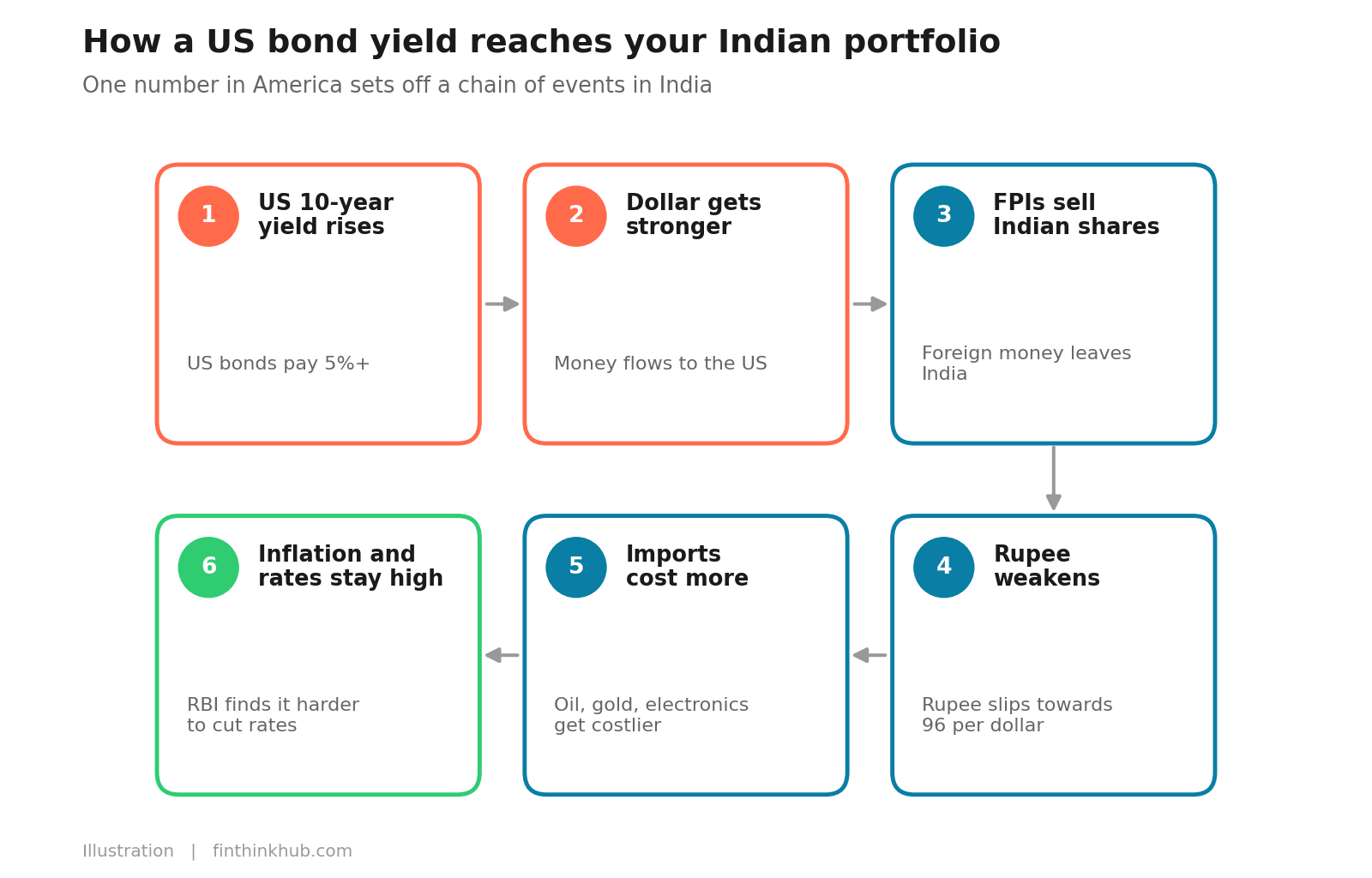
Imagine a pension fund in New York. When US bonds paid 4%, Indian shares looked exciting. Now US Treasuries offer a relatively low-risk dollar return of more than 5%, making riskier emerging-market assets like Indian shares less attractive at the margin. Add a falling rupee, and some funds decide to trim India and take the money home.
When many funds do this together, Indian shares fall, the rupee weakens, and the market mood turns nervous.
US yields are an important driver, but they are not the only reason foreign investors buy or sell Indian assets. Indian valuations, earnings expectations, crude prices, dollar strength, global risk appetite, how much money funds give to China and other emerging markets, and India's own growth and fiscal outlook all matter too. Think of the chain above as one strong force, not the whole story.
The "India premium" has almost vanished
Foreign investors ask one question: how much extra do I earn for taking the India risk? A simple measure is the gap between India's 10-year bond yield and America's.
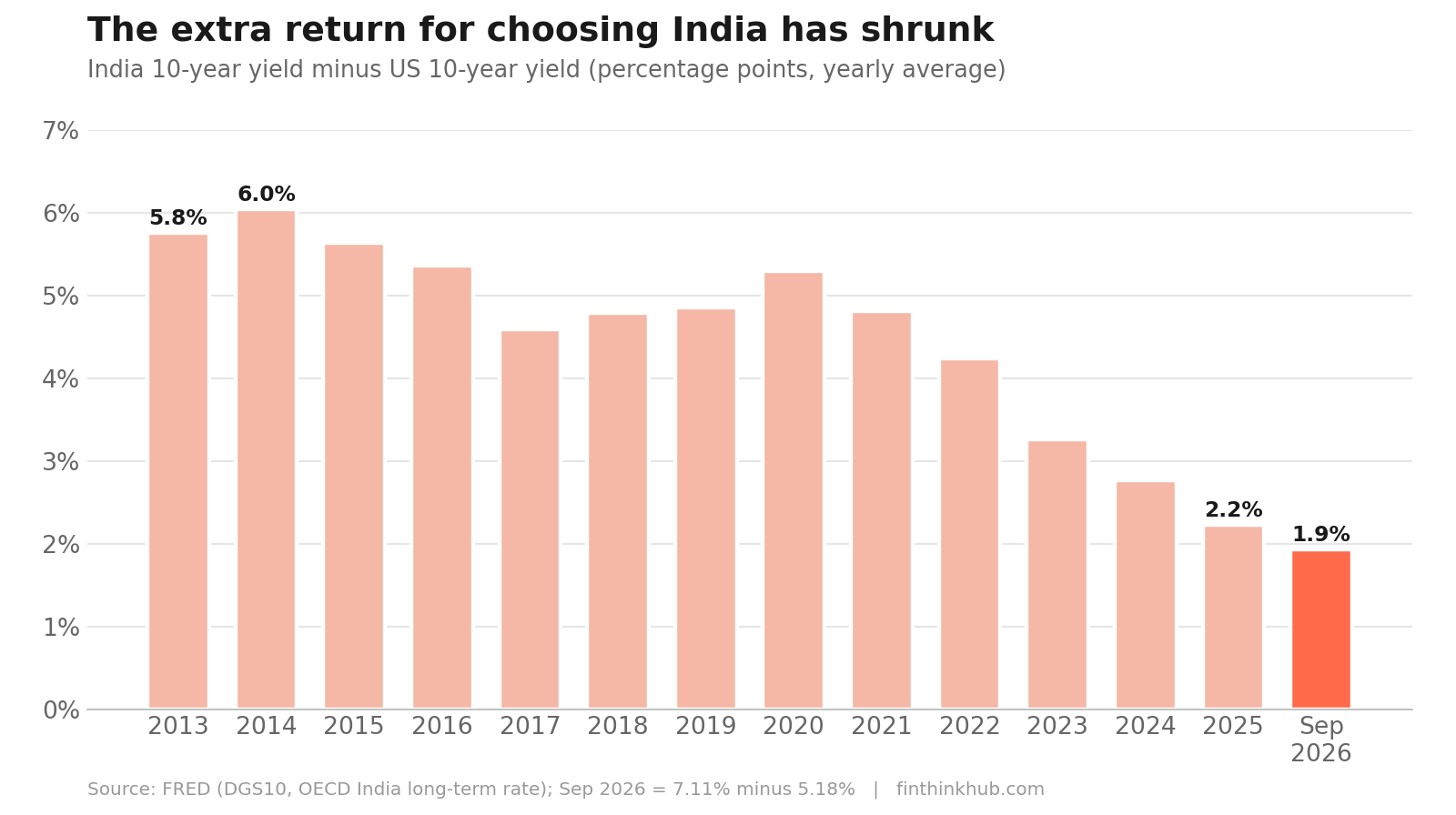
In 2014, India offered about 6% more than the US. Today, India's 10-year yield is around 7.11% and the US yield is about 5.18%. The gap is just about 1.9%, one of the lowest in over a decade.
Add a falling rupee, and a foreign investor earns almost nothing extra by choosing India. So the money leaves.
India's own tax rules are adding to the pain
The US yield is an outside problem. But over the last two years, our own government has also made investing in Indian shares costlier.
What changed?
Budget, July 2024: Short-term capital gains tax went up from 15% to 20%. Long-term capital gains tax went up from 10% to 12.5%. The tax-free limit moved only slightly, from ₹1 lakh to ₹1.25 lakh.
Budget 2026: STT (the tax you pay on every trade) on futures jumped from 0.02% to 0.05%, and on options from 0.10% to 0.15%, from April 1, 2026.
Dividends are taxed at your income slab, which can be above 30% for high earners.
Here's what that means in real money.
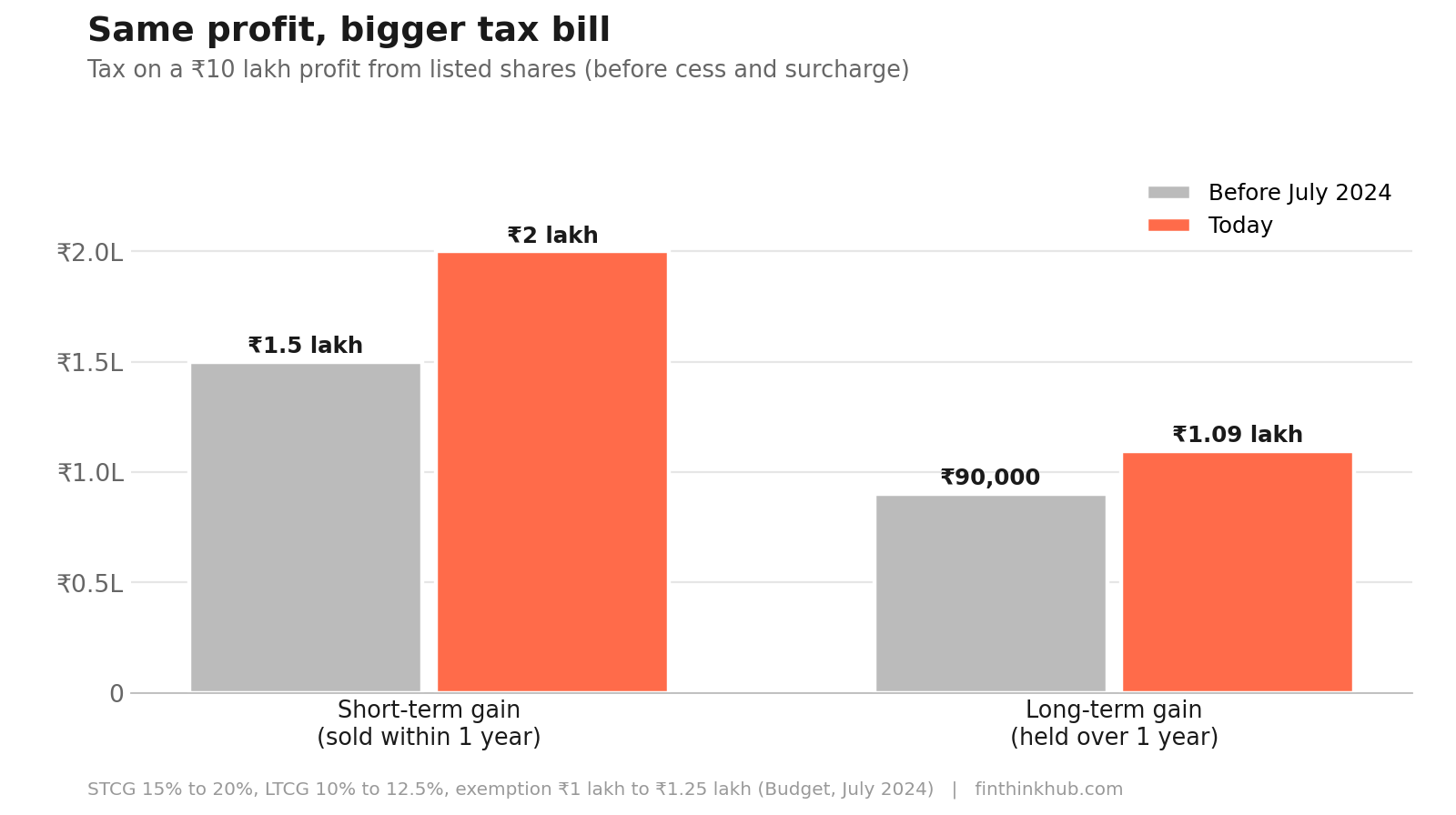
Say you earned a ₹10 lakh profit on shares. If you sold within a year, your tax is now ₹2 lakh instead of ₹1.5 lakh. If you held longer, it's about ₹1.09 lakh instead of ₹90,000. Same profit, bigger bill.
Why does this matter for foreign money?
A foreign fund compares its after-tax return across the world. And India looks costly on that scale.
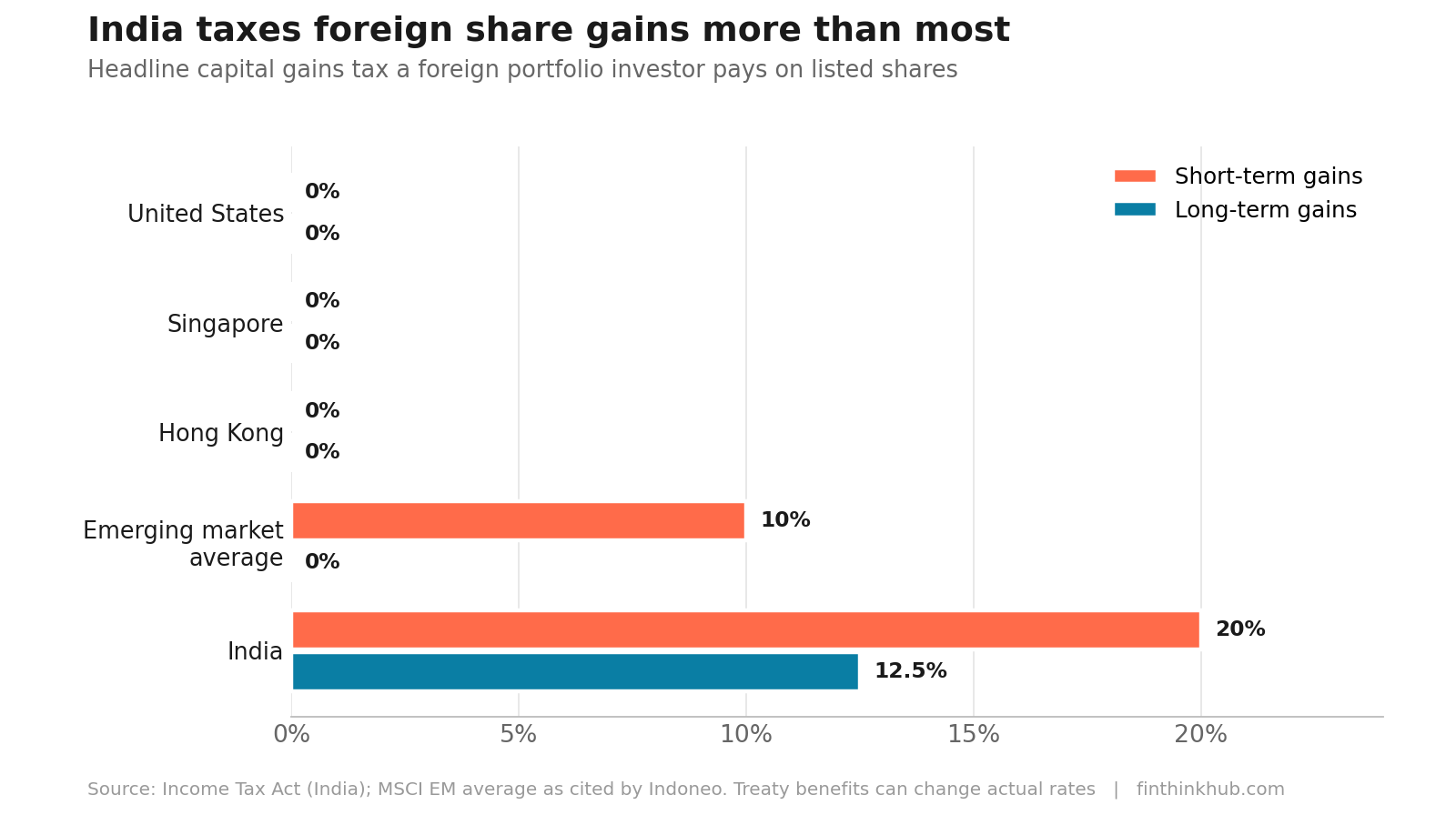
Foreign investors pay no capital gains tax on share profits in the US, Singapore or Hong Kong. India charges them 12.5% to 20%, plus surcharge and cess. Now put this next to a US bond paying over 5% with no such tax, and India has to work harder to win that money.
There's one more twist. From April 1, 2026, the government made interest and capital gains on Indian government bonds tax-free for foreign investors, to support the rupee. Equity got no such relief. So even inside India, the tax system now nudges foreign money towards bonds and away from shares.
In fairness, the government needs revenue, and exempting foreigners while taxing Indian investors would feel unfair. But the result is clear: when US yields are high, higher equity taxes make the "sell India" decision even easier.
Impact on the Indian economy
1. A weaker rupee
When dollars leave, the rupee falls.
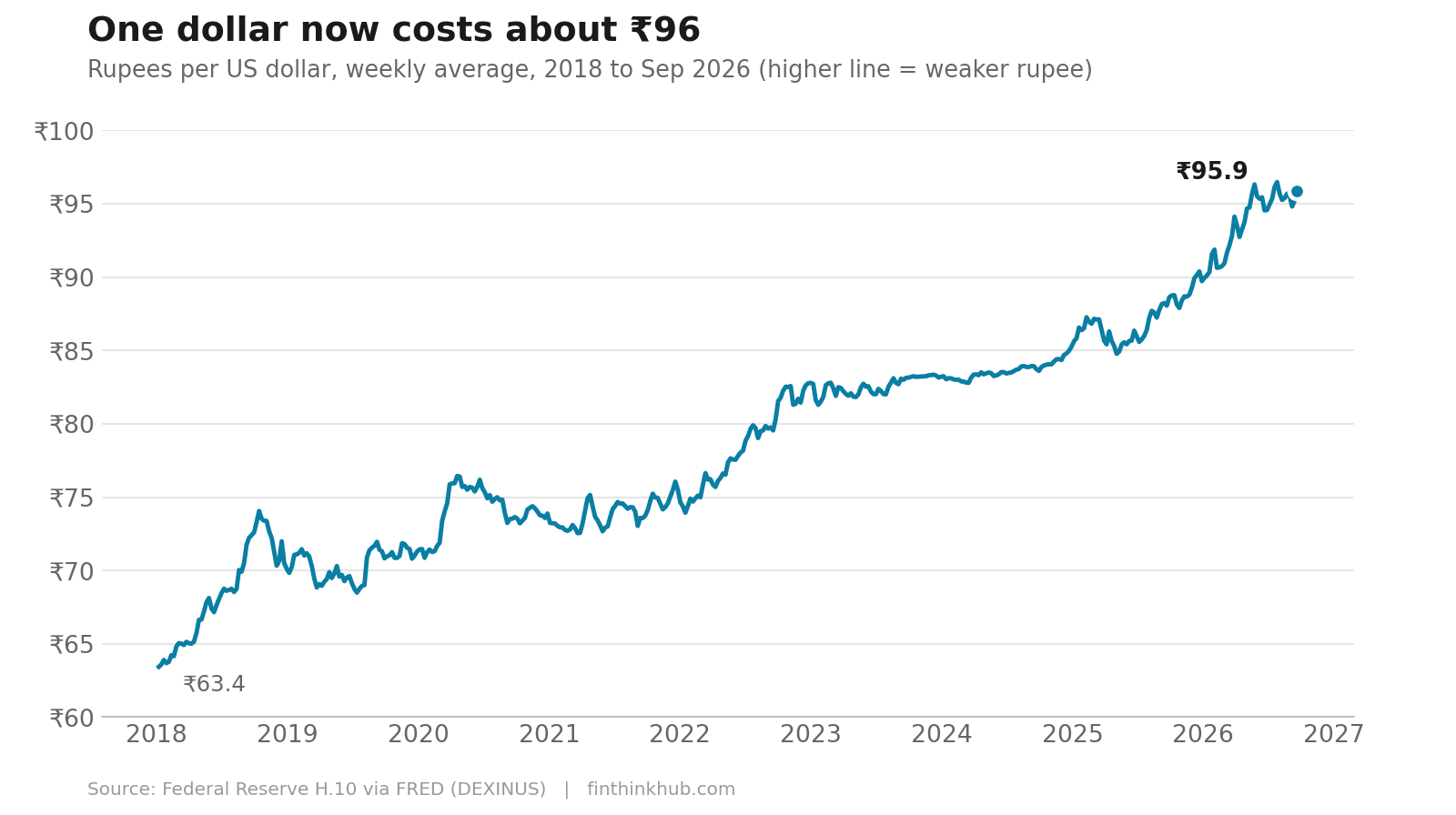
In 2018, one dollar cost around ₹64. Today it costs about ₹96. The RBI has been selling dollars to slow the fall, but it can't fight global forces forever.
2. Costlier imports and inflation
India imports around 85% of its crude oil and pays in dollars. A weaker rupee plus $100 oil is a double hit. Fuel, transport, gold, electronics and foreign education all get costlier. That student loan for your kid's master's degree in the US just became heavier.
3. Loans stay expensive
If the RBI cuts rates now, the gap narrows further and more money may leave. So home loan and car loan EMIs are unlikely to fall soon.
Impact on the Indian equity market
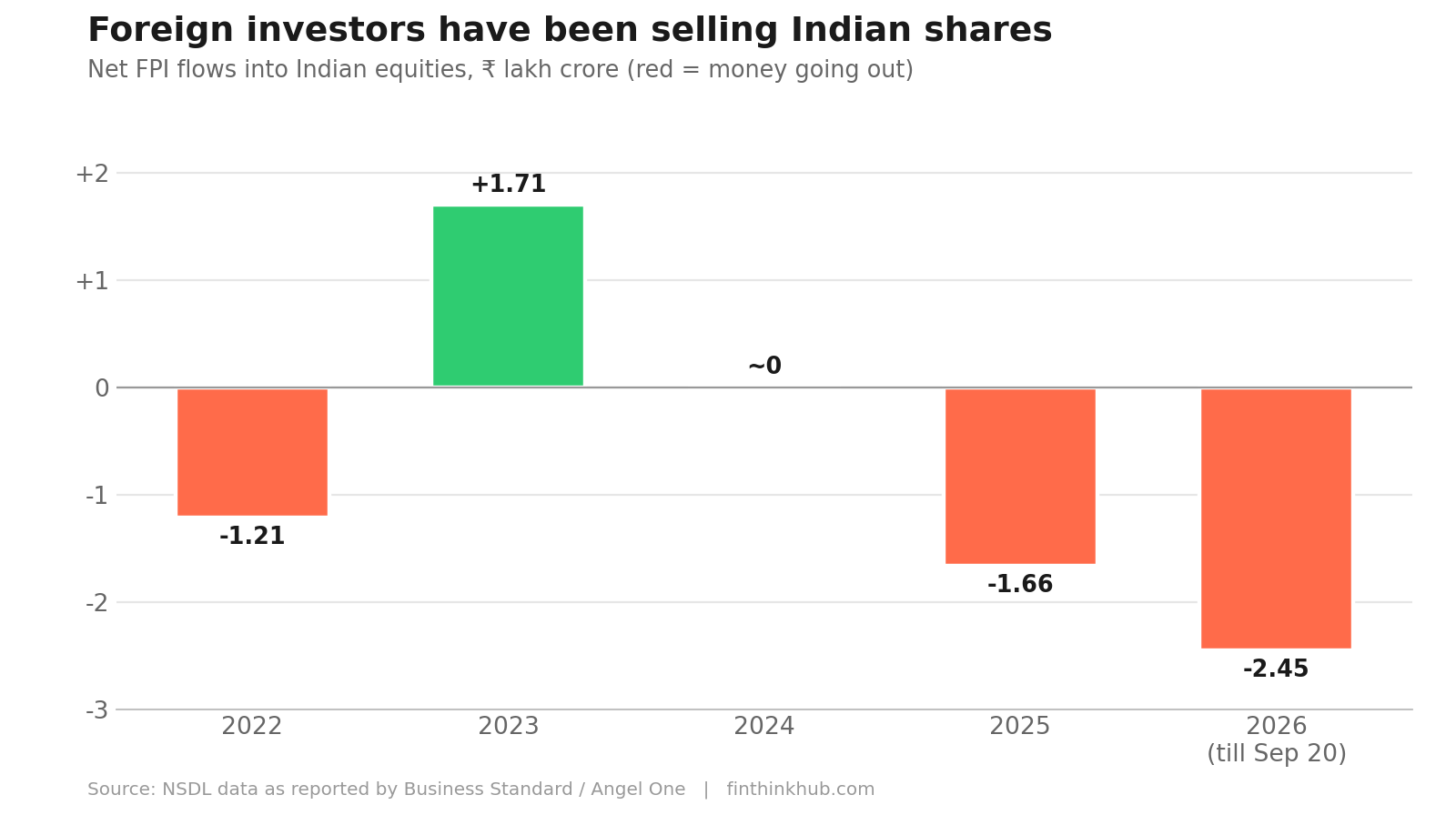
In 2026 alone, till September 20, FPIs pulled out about ₹2.45 lakh crore from Indian equities. That's already more than the whole of 2025.
Not all sectors feel the pain equally.
Sectors that usually get hurt:
Banks, NBFCs, real estate and autos: Higher rates mean costlier funds and fewer buyers.
Oil users: Paints, airlines, tyres and chemicals face higher raw material costs.
Small and mid caps: First to fall when fear rises.
Sectors that can hold up or even gain:
IT and pharma exporters: TCS, Infosys and drug exporters earn in dollars, so a weak rupee helps.
Oil producers: ONGC and Oil India gain from higher crude.
The good news: India isn't just foreign money anymore
Here's the calming part. In the same week that FPIs sold ₹11,490 crore, domestic institutions bought ₹16,398 crore.
That buying power comes from you, through monthly SIPs. Equity mutual funds received ₹29,329 crore in August 2026 alone, a four-month high.
Ten years ago, a big FPI sell-off could crash the market 20% or more. Today, the Nifty has fallen about 5.8% over seven weeks. That's painful, but it isn't a collapse. Indian savers are now the shock absorbers of their own market.
What should you do?
Think before pausing your SIP. For long-term investors, short-term FPI selling does not necessarily justify stopping an existing SIP. The more important question is whether your asset allocation still matches your goals and risk tolerance.
Know your debt funds. Rising yields hurt long-duration bond funds more than short-duration ones. Check which kind you hold.
Plan dollar expenses early. Don't wait for the rupee to "bounce back" before paying foreign fees.
Know your small-cap exposure. Small caps tend to swing more in phases like this, so check if your mix still suits your risk comfort.
Keep an emergency buffer. Having cash for needs means you won't be forced to sell investments at a bad time.
Know your ₹1.25 lakh tax-free limit. Long-term gains up to this amount each year are tax-free, and many investors plan their selling around it. A tax advisor can help you use it well.
The bottom line
The US 10-year bond yield is like the world's gravity. When it rises then it pulls money from everywhere back towards America. India feels that pull through a weaker rupee, costlier imports, sticky loan rates and foreign selling. Higher taxes on equity at home make that pull even stronger.
But India today is far stronger than it was during the 2013 "taper tantrum." We have higher forex reserves and a huge army of domestic SIP investors. So watch the US yield, but don't let it scare you out of your long-term plan.
Next time the Nifty falls on a day with no Indian news, the US 10-year yield is one of the first things worth checking.
References
US 10-year Treasury yield (DGS10), India long-term rate and USD/INR (DEXINUS): FRED, St. Louis Fed
US yield drivers and levels: Trading Economics
FPI outflows in September 2026: Angel One
Rupee, Indian bond yields and RBI action: Business Standard
Nifty weekly performance and FII/DII flows: Sunday Guardian
Equity tax rates and Budget 2026 STT changes: Tata Mutual Fund, Business Standard, Budget 2024
Tax exemption for FPIs on government bonds: Outlook Business
FPI tax comparison and policy debate: Indoneo, Republic World
Mutual fund inflows August 2026: Upstox
Responses (0)
Leave a response
Related Articles

GuideFin: A Real Plan Not Just Another Investment App
Why the middle class Indian investor doesn't need another place to invest. They need a clear plan, and an honest way to …

How India's Economy Works: Applying Ray Dalio's Economic Machine Framework
There's a 30 minute animated video on YouTube. No celebrity drama, Just a man named Ray Dalio sitting down and explainin…