France Borrowed Like There Was No Tomorrow. Now Tomorrow Is Here.
What one of the world's richest countries can teach you about debt Last week, something happened in Paris that hadn't happened in 24 years. The interest rate…
What one of the world's richest countries can teach you about debt
Last week, something happened in Paris that hadn't happened in 24 years. The interest rate lenders ask from France on a new 10-year loan went above 5%.
That might sound small. It isn't. A few years ago, France was borrowing at close to zero. And people are out on the streets, angry about a budget that hasn't even passed yet.
So how did a rich country with great trains, great food and great hospitals end up here? It's a story every family, business and government should know.
Start With a Family
Imagine a family that earns ₹1 lakh a month.
They spend ₹1.1 lakh. The extra ₹10,000 goes on a credit card. Next month, same thing. And the month after.
At first, nothing bad happens. The bank is happy to lend. Life feels good. But every month the card balance grows, and so does the interest on it. One day the family notices that a big part of their salary goes just to pay interest on old spending. Not on food. Not on school fees. On interest.
France is in a similar spot. A country isn't exactly a family. It can raise taxes, grow its economy and roll old loans into new ones. But the basic rule is the same: if you spend more than you earn every year, the debt piles up.
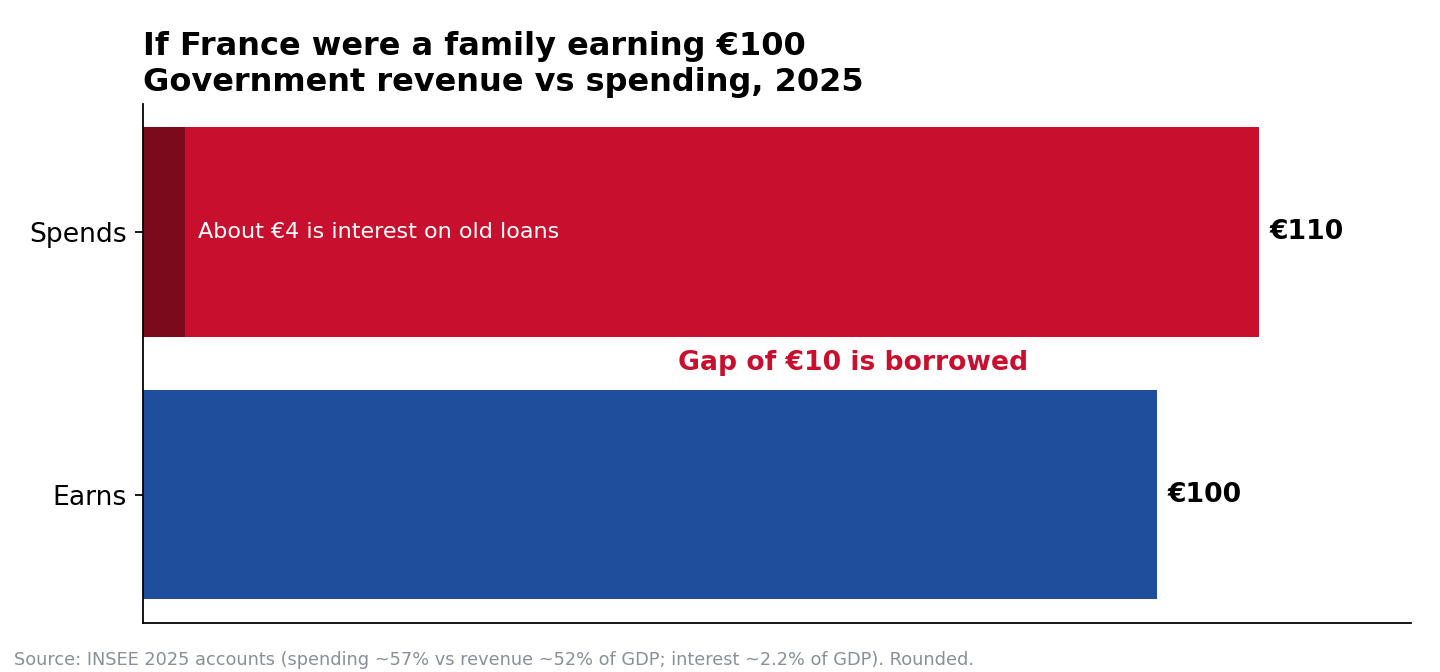
In 2025, for every €100 the French government took in, it spent about €110. The gap was borrowed. And roughly €4 of that spending went on interest for money borrowed years ago.
How Big Is the Hole?
France's public debt was 115.7% of its GDP at the end of 2025. The government expects it to reach about 119% this year. In simple words, the country owes more than everything it produces in a full year.
It wasn't always like this. In 2007, the number was about 65%. Then came the 2008 financial crisis. Then COVID. Then the energy shock. Each time, the government spent heavily to protect jobs and businesses. That part made sense.
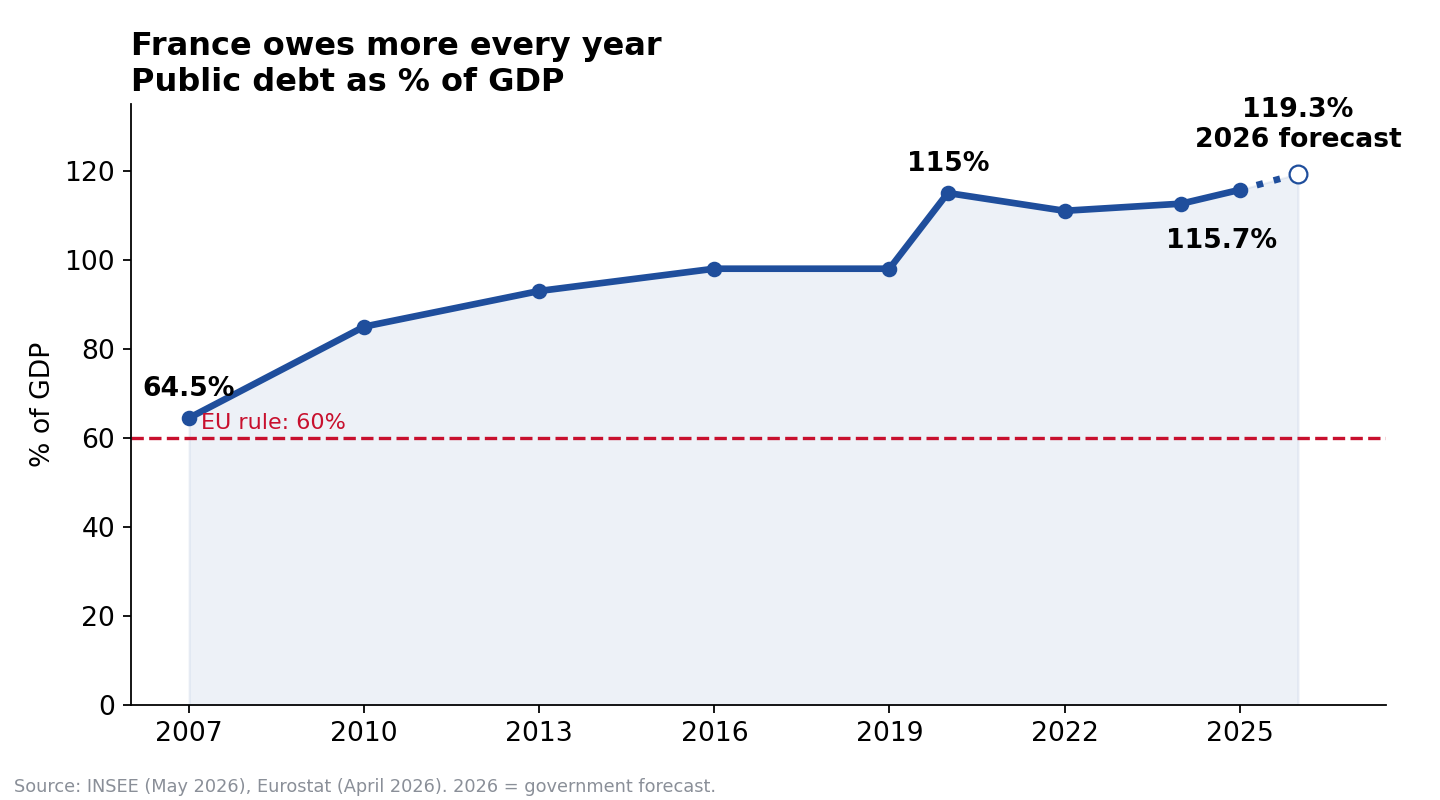
The problem is what happened after. When each crisis passed, the yearly gap between earning and spending stayed wide. So the debt went up in bad years and stayed up in good years.
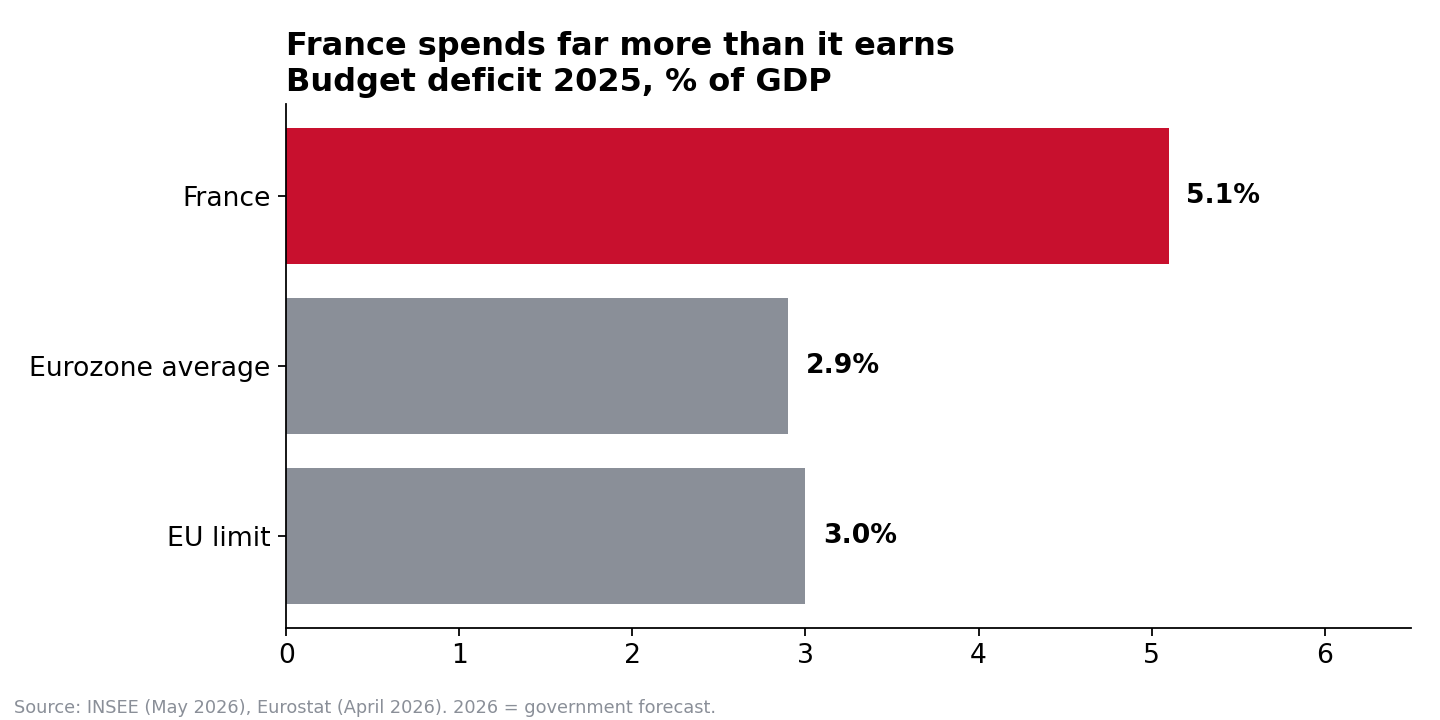
EU rules treat a yearly deficit of 3% of GDP as the warning line. France's deficit was 5.1% in 2025. That's better than 5.8% in 2024, but not enough to stop the debt from rising. The eurozone average was 2.9%.
Why Didn't Anyone Stop?
Because for years, borrowing was almost free.
Between 2015 and 2021, France could borrow for 10 years at close to 0%. In 2020, some French bonds even had negative rates, which means lenders were paying France to hold their money. When loans cost so little, cutting spending feels pointless. Why upset voters when you can just borrow a bit more?
Think of it like a home loan at 0% interest. You'd probably buy a bigger house too.
But cheap money doesn't last forever. In 2022, prices started rising across the world. Central banks raised rates to control it. And every time France's old loans came due, it had to borrow again at the new, higher rate.
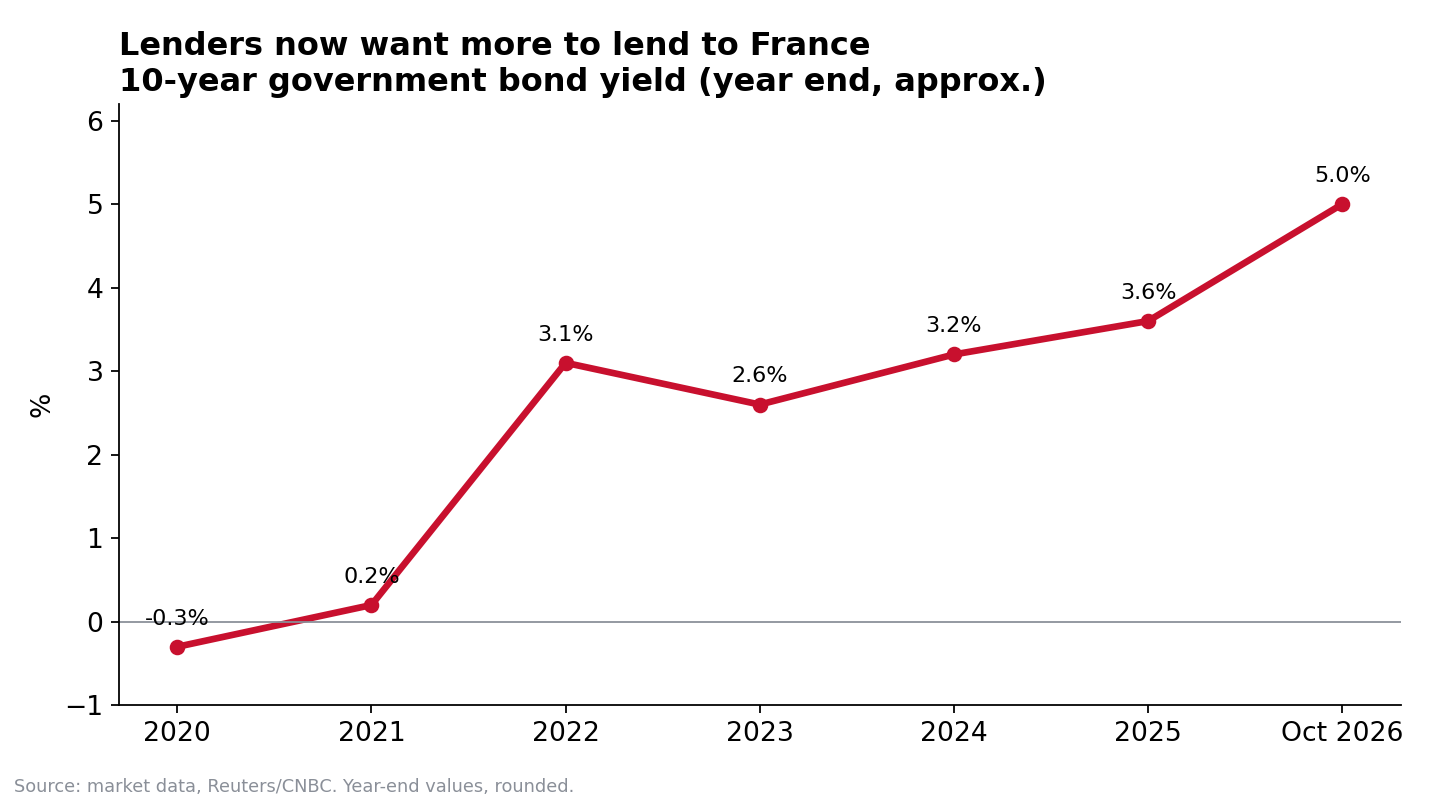
A 5% yield doesn't mean France suddenly pays 5% on everything it owes. Old loans keep their old rates. But each new loan costs more, and slowly the whole bill climbs. The state's own interest bill was about €36 billion in 2020. It's budgeted at €62.6 billion this year and €72.9 billion next year. Add towns, regions and social security, and the total was about €65 billion in 2025.
Then Politics Made It Worse
Here's the part that turned a slow problem into a fast one.
France is under pressure to shrink its deficit. But politicians can't agree on how. Cut pensions? People protest. Raise taxes on the rich? Businesses complain. Cut public services? Unions strike.
France's parliament is split into groups that rarely agree. Governments have fallen one after another over budget fights. The current Prime Minister, Sébastien Lecornu, says the 2027 budget needs a €54 billion effort just to stop the deficit from getting worse. Lawmakers are still arguing, and the streets are angry.
Lenders watch all of this. Rates are high around the world right now, including in the US. But when lenders see high debt, big deficits and a parliament that can't agree on a fix, they ask for a bit extra on top. Together, these pushed France past 5%.
The Trap
This is the part that should worry everyone.
Higher interest means a bigger interest bill. A bigger bill means a bigger deficit. A bigger deficit means more borrowing. More borrowing makes lenders even more nervous. So they ask for even higher interest.
It's a circle, and it spins faster the longer you wait.
France isn't Greece. It's a huge economy with strong institutions, and it isn't about to go bankrupt. But size doesn't make it safe. It has less room every year, and when the next crisis comes, France will have less money to fight it.
The Lessons for Everyone
The French story isn't only about France. The same rules apply to you, your business and your country.
1. Borrowing in a crisis is fine. Not closing the gap after is the problem. France was right to spend during COVID. The mistake was letting the yearly gap stay wide once the crisis passed. If you take a loan for a medical emergency, that's smart. If you keep using the card after you recover, that's a habit.
2. Cheap loans hide bad habits. When EMIs are low, everything looks affordable. The real test is what happens when rates go up. Before any loan ask yourself: could I still pay this if the rate went up by 3%?
3. Interest doesn't buy anything new. Every rupee you pay in interest is a rupee you can't spend on your goals. As France's interest bill grows, it squeezes out money for schools, hospitals and defence. Watch how much of your own income goes to interest. If it keeps growing, that's your warning sign.
4. Trust is hard to win back. Lenders don't only look at numbers. They look at whether you have a believable plan. A person with a clear plan to repay gets a better rate than a person who keeps making excuses. Countries are no different.
5. The longer you wait, the harder it gets. Fixing a 3% deficit is uncomfortable. Fixing a 5% deficit with 5% interest rates is painful. Small changes early beat big changes late. Every time.
The Bottom Line
France didn't get into trouble because of one bad decision. It got there through hundreds of small, comfortable ones. Spend a little more. Borrow a little more. Fix it next year.
Next year always comes. For France, the warning came in October 2026.
The good news? The lesson is free. You don't have to learn it the French way.
Sources:
Responses (0)
Leave a response
Related Articles

Gold SIPs Are Paused. Gold Loans Are Booming. What's Driving Both?
On 16 October'26, plenty of people opened their mutual fund app to start a gold SIP before Diwali and couldn't.Around 17…
Why a 5% Bond Yield in America Is Shaking Your Portfolio in India
Open your mutual fund app this month and you will probably see in red. The Nifty has fallen for seven weeks in a row, an…

GuideFin: A Real Plan Not Just Another Investment App
Why the middle class Indian investor doesn't need another place to invest. They need a clear plan, and an honest way to …