Gold SIPs Are Paused. Gold Loans Are Booming. What's Driving Both?
On 16 October'26, plenty of people opened their mutual fund app to start a gold SIP before Diwali and couldn't. Around 17 fund houses, including Tata, DSP,…

On 16 October'26, plenty of people opened their mutual fund app to start a gold SIP before Diwali and couldn't.
Around 17 fund houses, including Tata, DSP, Kotak and ICICI Prudential, had stopped taking fresh lump sums and new SIP registrations in their gold fund of funds (Moneylife, Business Today, 15 to 16 October 2026). Some, like HDFC, Kotak and UTI, also paused bulk orders in their gold ETFs (Reuters).
In the same year, loans against gold have nearly doubled.
It's tempting to call that one master plan. The evidence doesn't support that. These are two separate trends with different drivers.
What changed on 15 and 16 October
Here's what you can and can't do right now:
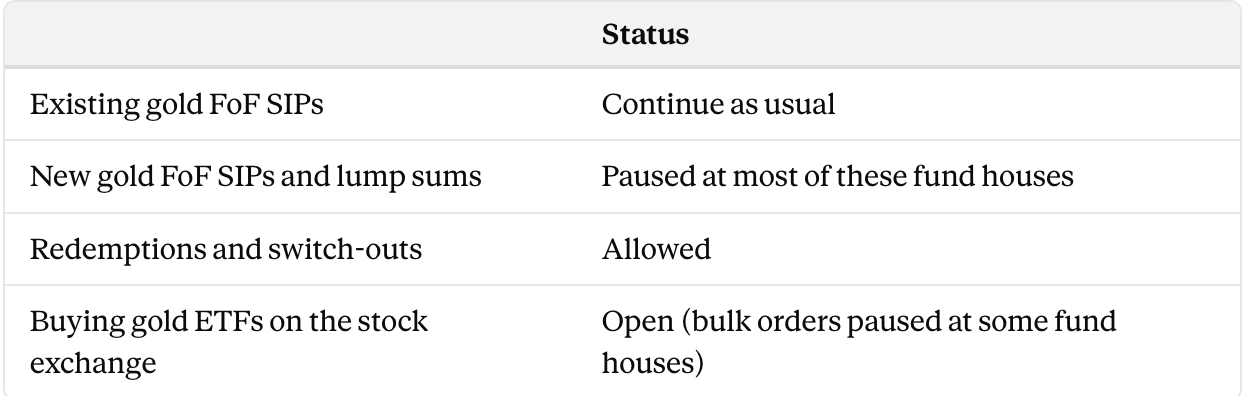
Now, the "why." The fund houses gave no reason in their notices. Reuters reported that a fund executive said the decision followed discussions with SEBI, and bullion industry officials described a nudge from the regulator. DSP's notice reportedly referred to SEBI directions (Moneylife). As of 17 October 2026, neither SEBI nor the government has publicly confirmed a motive, and there's no official circular.
So we know what fund houses announced, not officially why. Most reporting points to the rupee. Does that hold up?
Why gold investment matters to the rupee
India mines very little gold. Most of what we buy is imported, and importers pay in US dollars. Indians bought 710.9 tonnes of gold in 2025 (Business Today), which makes gold one of the larger items on our import bill.
Now follow Priya in Pune, who starts a ₹5,000 gold SIP.
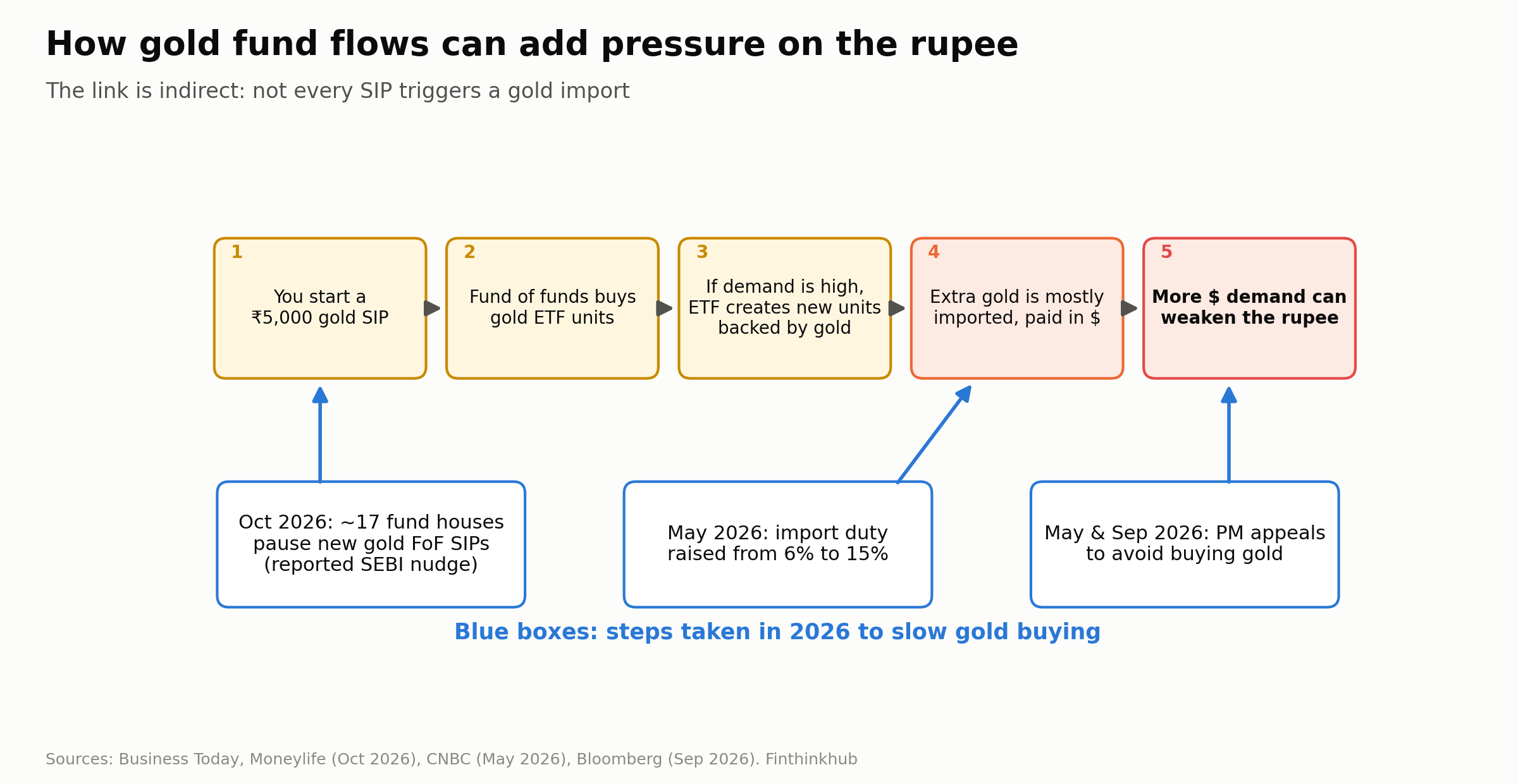
Her fund of funds buys units of a gold ETF. Here's the part most people miss, that doesn't automatically trigger a gold import. ETF units also trade on the exchange, so her money might just buy units someone else is selling.
New units, and so new physical gold, come in only when buying keeps running ahead of the units already available. Large market players then create fresh units, and the gold backing them largely comes from abroad. Gold ETF assets crossed ₹1.86 lakh crore on 30 September 2026, more than double the ₹90,136 crore a year earlier (AMFI data via Business Today). Part of that jump is higher gold prices, not just new money.
So the effect is indirect. Gold investment can add to dollar demand, but how much depends on prices, jewellery demand, recycled gold and everything else India imports.
And the rupee is under real pressure. It closed around 96.72 per dollar on 9 October and near 95 a week later (Business Today). Oil prices and foreign selling of Indian shares are the bigger reasons. A weaker rupee makes imports costlier, which feeds inflation.
The government has already acted on gold. Import duty went from 6% to 15% in May 2026 (CNBC), and PM Modi asked people in May and again in September to avoid buying gold if they don't need it (Bloomberg). Gold imports fell 81% year on year in September to about $1.8 billion, and 27% for April to September (Commerce Ministry data via PTI and ANI). How much of that fall came from the duty, rather than high prices, isn't clear.
One bullion dealer even called the fund pause surprising, since imports had already fallen so sharply (Reuters). So treat the rupee explanation as likely, not proven.
Why gold loans are growing
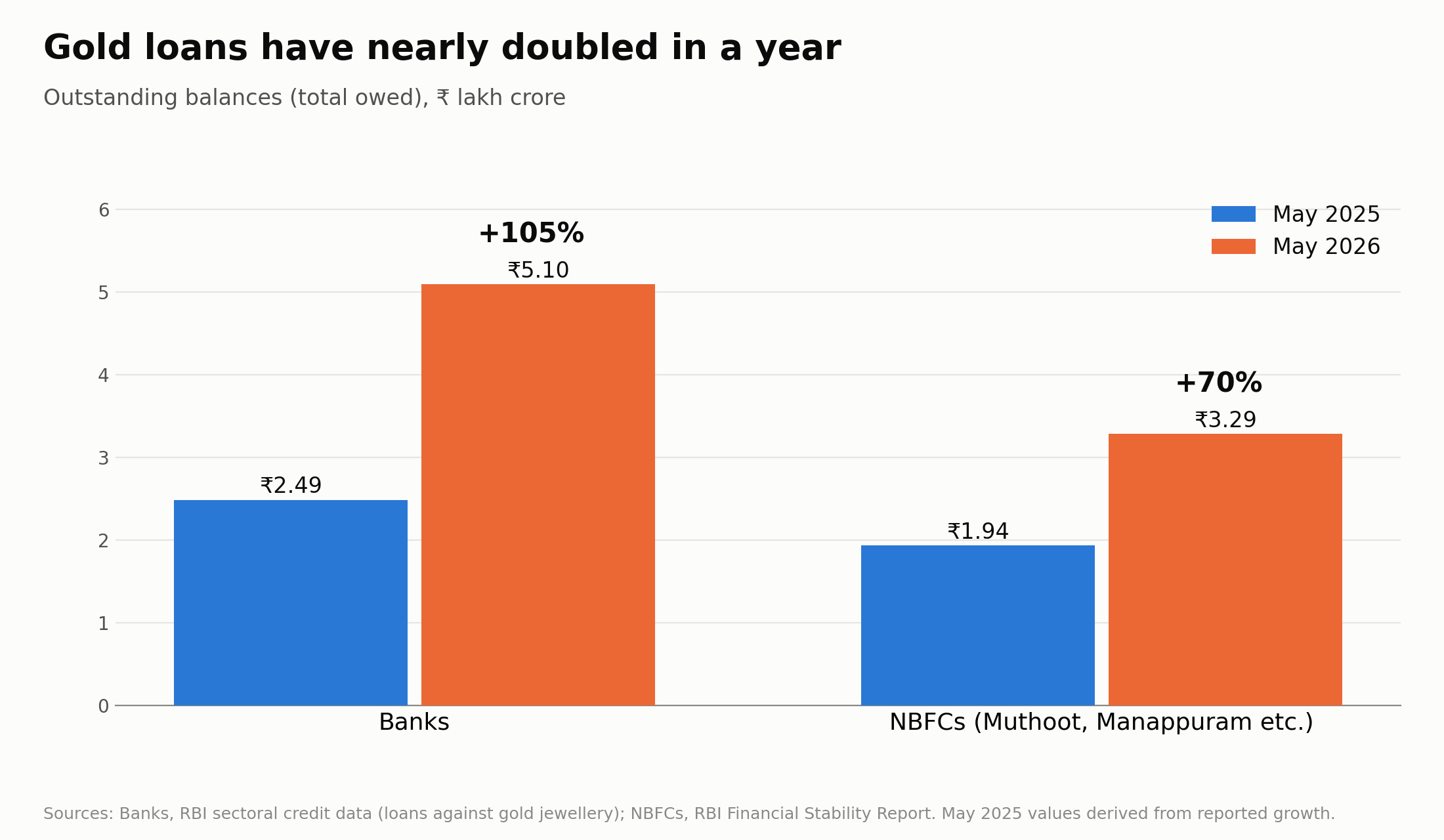
Bank loans against gold jewellery stood at about ₹5.1 lakh crore at the end of May 2026, up about 105% in a year (RBI sectoral credit data, via Multibagg). NBFC gold loans, from lenders like Muthoot and Manappuram, were about ₹3.29 lakh crore as of May 2026, up about 70% (RBI Financial Stability Report, as reported). Both numbers are outstanding balances, the total money owed at that point. They don't tell you how many new borrowers there are.
Three things are pushing these balances up.
Gold prices. 24 carat gold was around ₹1,45,940 per 10 grams on 16 October (IBJA, via Goodreturns). When gold is pricier, the same 50 grams in your locker supports a bigger loan. Balances can grow even if the number of borrowers doesn't.
Lending rules. RBI's Lending Against Gold and Silver Collateral Directions, 2025 came into effect on 1 April 2026. For smaller loans, up to ₹2.5 lakh, the maximum loan-to-value is now 85%, up from the earlier 75% cap. Bigger loans get lower ceilings: 80% up to ₹5 lakh and 75% above that. And 85% is a ceiling, not a promise. Lenders can offer less, and the 85% has to hold for the whole loan, not just on day one.
Lender behaviour. In November 2023, RBI raised the risk weights, meaning the capital lenders must set aside, on certain kinds of unsecured consumer credit, including many personal loans and credit card dues. The exact treatment varied by lender type and loan category, but loans backed by gold were kept out. That didn't change who qualifies for a personal loan, but it made gold-backed lending relatively cheaper for lenders to grow, so many pushed harder into it.
None of these needs a plan to "replace" gold buying with gold borrowing.
Is borrowing against old gold better for the economy?
There is one genuine link between the two stories.
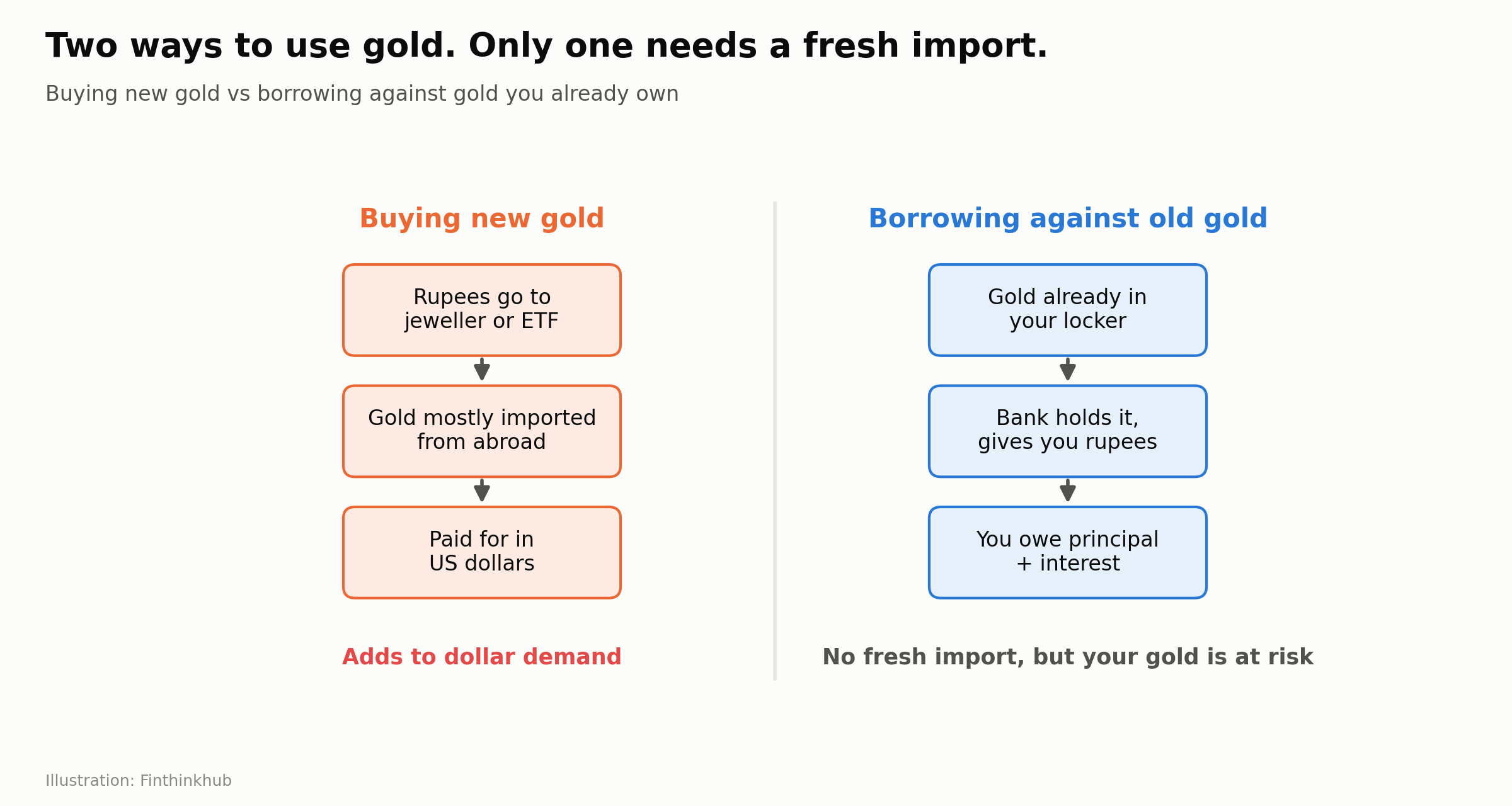
When you buy new gold, it usually has to be imported. When you borrow against gold you already own, no fresh import is needed. The bank holds your jewellery and gives you rupees. That matters for the country's dollar balance.
But it isn't free money. You pay interest, you owe the principal, and your jewellery is at stake. And the rupees you borrow may still end up buying imported things, so "no dollars leave" would be too strong. Gold loans put idle household gold to work, but they also turn family savings into debt.
The risks borrowers should know
Gold loans carry gold price risk. But your ability to repay matters just as much.
Say Rahul pledges gold worth ₹1 lakh and borrows ₹85,000. If gold falls 15%, his gold is worth ₹85,000. The lender's cushion is gone. He may be asked to repay part of the loan or add more gold, and if he can't, the gold can be auctioned. Gold fell four days in a row in mid-October (Goodreturns), a small reminder that prices move both ways.
And prices aren't the only risk. If Rahul's income dips, he can default even while gold stays flat, and the jewellery still goes to auction.
For a household, the bigger worry is borrowing against jewellery to pay daily bills. That's a sign of stress, not strength.
What this means for you
If you already have a gold FoF SIP, it keeps running. If you want gold exposure, gold ETFs on the exchange are still open. Physical and digital gold are available too, though their price now reflects the higher duty.
A gold loan isn't an investment strategy. It's borrowing. Use it for a clear need, ideally one that pays you back, and leave room in case prices fall.
Gold has long been India's emergency reserve. That still holds. Just remember that once it sits in a lender's vault, it comes with a repayment date.
Data as of 17 October 2026. Fund house rules, gold prices and the rupee change quickly. Check your fund house's latest notice before acting. This article explains the economics and is not investment advice.
Responses (0)
Leave a response
Related Articles

France Borrowed Like There Was No Tomorrow. Now Tomorrow Is Here.
What one of the world's richest countries can teach you about debtLast week, something happened in Paris that hadn't hap…

Why a 5% Bond Yield in America Is Shaking Your Portfolio in India
Open your mutual fund app this month and you will probably see in red. The Nifty has fallen for seven weeks in a row, an…

GuideFin: A Real Plan Not Just Another Investment App
Why the middle class Indian investor doesn't need another place to invest. They need a clear plan, and an honest way to …