How Invoice Discounting Apps Are Growing in India
Most Indians learn investing in the same order: 1st savings account, then FD, then mutual funds and SIPs, then maybe NPS, then bonds. Over the last few years,…
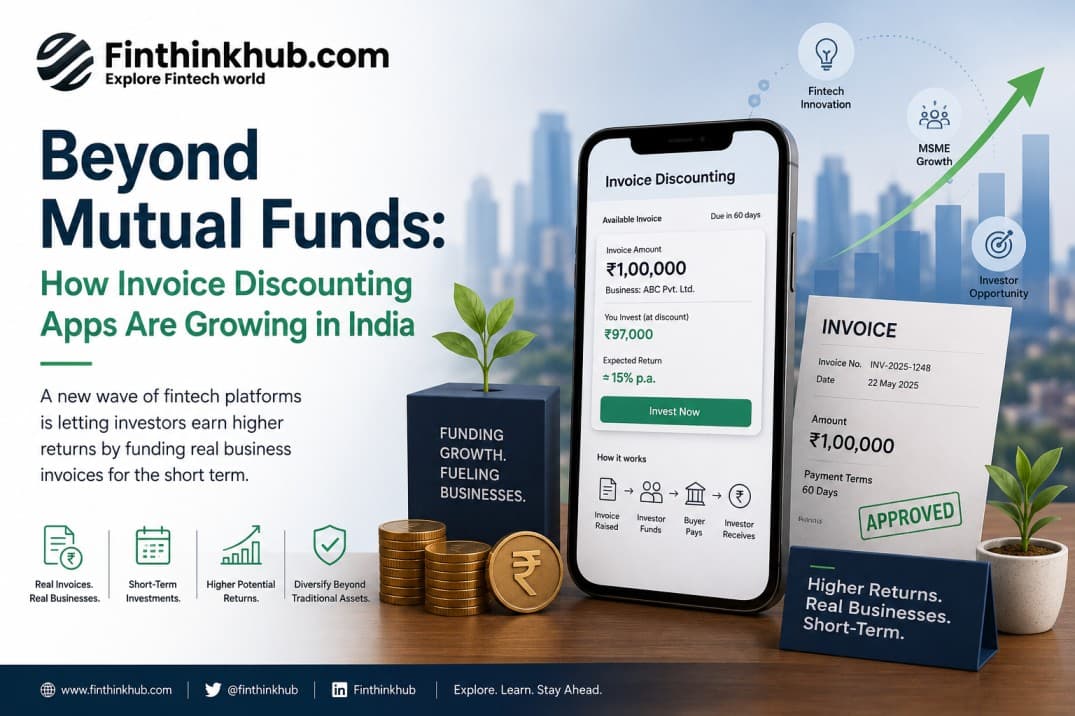
Most Indians learn investing in the same order: 1st savings account, then FD, then mutual funds and SIPs, then maybe NPS, then bonds. Over the last few years, that old bundle has started coming apart. Fixed income and business financing, once packaged inside banks and mutual funds, are splitting into narrower, digital-first products. Invoice discounting is one of them.
Apps like KredX, TradeCred, and Ultra offer retail investors ways to take exposure to specific unpaid business invoices, typically through privately structured transactions, paying less than an invoice's face value now and collecting more once it is paid.
How it works

Say a business raises a ₹1,00,000 invoice and its buyer will pay in 60 days. The business lists it on a fintech app because it wants cash sooner. You buy the invoice at a discount, say ₹97,000. When the buyer pays, the platform passes the full ₹1,00,000 to you. Your profit is ₹3,000 in 60 days.
For the business, that ₹3,000 discount is the price of getting ₹97,000 today instead of waiting 60 days for the full ₹1,00,000. That cash can go straight to paying suppliers, meeting payroll, or funding its next order, which is often worth more to a small business than the ₹3,000 it gives up.
Turning that into a yearly number makes it look bigger than it is. Ultra advertises annualised yields up to 15% and KredX quotes 12% to 20%. That assumes you can redeploy money at the same yield all year with no gaps and no defaults, which nothing guarantees. The expected return is typically known upfront, but the actual return depends on whether the invoice is paid as expected, not on a fixed promise.
It also matters who you are trusting. The business is the seller, its buyer owes the payment, and the platform usually sits in between, moving money through a bank escrow account rather than holding it itself. Your money is at risk if the buyer does not pay on time, and how easily you get it back depends on that particular platform's contract, not one industry-wide rule.
TReDS and retail apps are not quite the same thing
RBI already regulates a large form of invoice financing called TReDS. TReDS operates within RBI's regulatory framework, with banks and eligible RBI-registered NBFC-Factors participating as financiers. Individual retail investors cannot participate directly on TReDS. That restriction traces back to the Factoring Regulation Act, 2011, which limits who can legally act as a "factor" in the first place.
This is why many retail invoice-discounting apps operate outside the specific TReDS framework and outside SEBI's Online Bond Platform Provider (OBPP) rules, structuring deals as private assignment contracts between a business and an investor instead. The exact regulatory treatment depends on how each platform has legally structured its transactions, and this should not be read as a blanket rule for every app. KredX, for one, runs an RBI-licensed TReDS business called DTX for institutional financiers, separate from its retail marketplace, which routes investor funds through ICICI Bank escrow accounts.
Who are the players, and how do their models differ
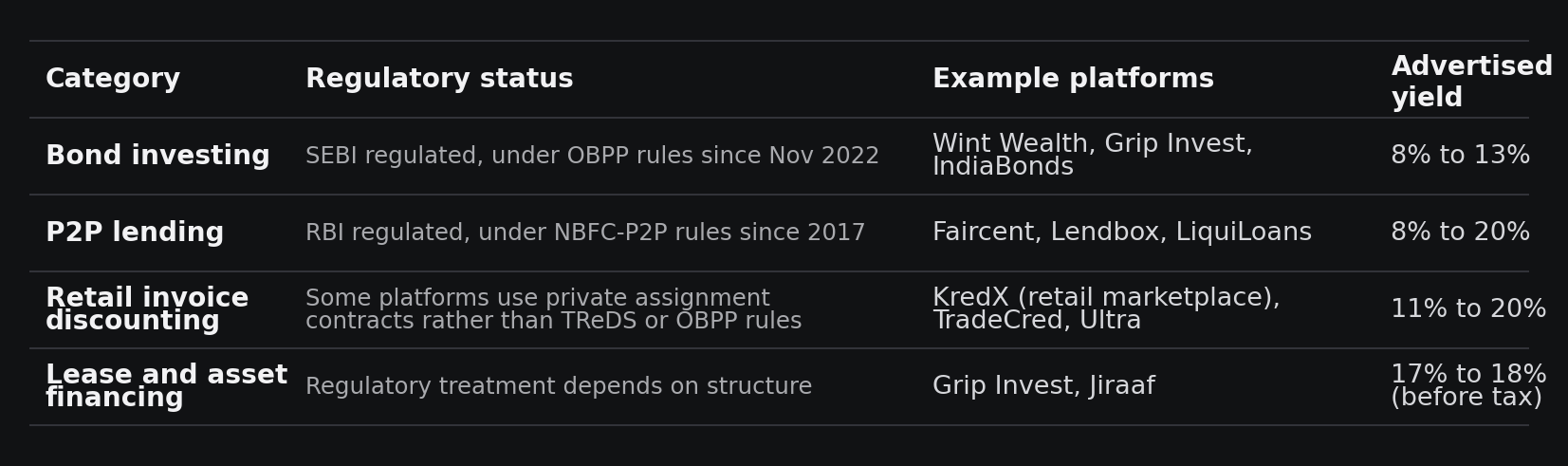
Products offering higher advertised yields can also involve different and less familiar forms of credit, liquidity, concentration, and investor-protection risk than bond and P2P platforms, which sit inside clear SEBI and RBI frameworks with set disclosure rules and complaint timelines. That does not make these apps frauds. Many do real diligence on the invoices they list. It means the higher yield comes with a risk this article is describing, not recommending.
Why this is growing, and how big it is
Indian MSMEs need approx. about ₹70 lakh crore in working capital a year; only about a quarter comes through formal channels, leaving a gap CRISIL puts at ₹52.2 lakh crore. That figure describes the overall MSME credit gap, not a market size for invoice-discounting apps specifically. It simply creates a broad backdrop against which alternative working-capital products, including invoice financing, have room to grow. On the investor side, FD and bond yields have stayed fairly modest, so a 60 or 90 day product quoting double digits stands out, and cheap mobile KYC has made it easy for new platforms to launch since around 2018.
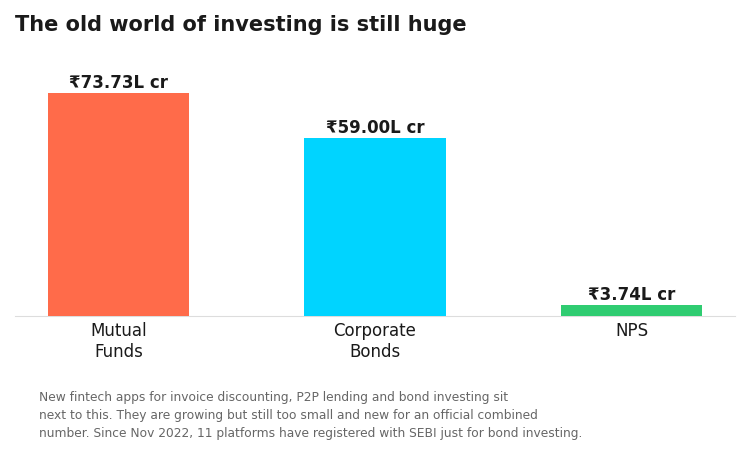
Against that backdrop, the established investment markets are orders of magnitude larger, while the size of the retail invoice-discounting market remains difficult to measure. Mutual funds held about ₹73.73 lakh crore in FY26 (AMFI), corporate bonds around ₹59 lakh crore (2025 data), and NPS crossed ₹3.74 lakh crore in assets by March 2026, a separate count from its over 6.6 crore subscribers including Atal Pension Yojana (PFRDA, PIB). There is no reliable combined figure for invoice discounting, P2P, and leasing platforms together, so this is not a clean size comparison, just context. SEBI's OBPP rules have brought 11 platforms into that framework since November 2022, and proposed a new bond distribution model in August 2026 to reach more retail investors, a sign this space keeps evolving.
The risk is real, not theoretical
In December 2023, an invoice deal linked to Arzooo on the AltGraaf platform ran into repayment trouble, with investor repayments subsequently made in parts over the following year rather than on the original schedule. AltGraaf has said it filed a criminal complaint against Arzooo in Bengaluru. The episode is a visible example of how quickly a single-invoice credit exposure can turn into a drawn-out recovery process, and it is worth knowing about even without a precise, independently verified recovery number. Default risk on a single company is real here, not theoretical.
In short
Invoice discounting lets an investor take on one company's unpaid invoice at a discount and collect it later. Some apps route around the TReDS and OBPP rules built for institutional financiers, using private contracts instead; others sit inside SEBI or RBI frameworks. The established investment markets are orders of magnitude larger and come with clearer rules; this newer, unbundled layer of fixed income offers a different shape of return and risk, one invoice at a time. How to weigh that is a personal call.
Sources:
AMFI/IBEF (mutual fund AUM); Factoring Regulation Act, 2011 (India Code, bare act text);
RBI's TReDS framework
KredX FAQ (retail escrow structure vs its DTX TReDS platform)
SEBI OBPP registrations via The Alt Investor; Business Standard (SEBI's August 2026 bond distribution proposal)
PFRDA and PIB (NPS AUM and subscribers); AltGraaf Investors Community tracker (Arzooo repayment timeline)Ultra and KredX platform pages (advertised yields, as of August 2026).
Responses (0)
Leave a response
Related Articles

GuideFin: A Real Plan Not Just Another Investment App
Why the middle class Indian investor doesn't need another place to invest. They need a clear plan, and an honest way to …
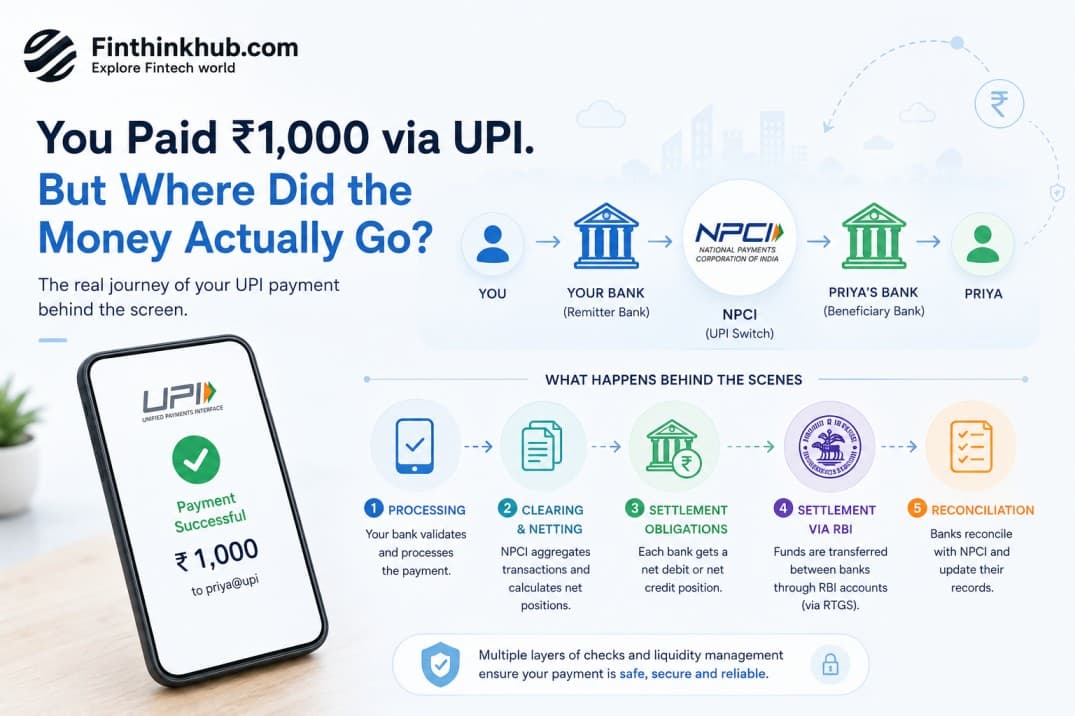
What Happens When You Send Money on UPI: A Complete Breakdown
You send ₹1,000 to Tarun who is your colleague in Noida on UPI. Your phone buzzes, the app shows a green tick, "Payment …
PostHog Didn't Find Bugs. It Found My Wrong Assumptions
Sentry told me when GuideFin broke. PostHog told me something harder to hear: a working app isn't the same as a used app…