What Happens When You Send Money on UPI: A Complete Breakdown
You send ₹1,000 to Tarun who is your colleague in Noida on UPI. Your phone buzzes, the app shows a green tick, "Payment Successful," and you get on with your…
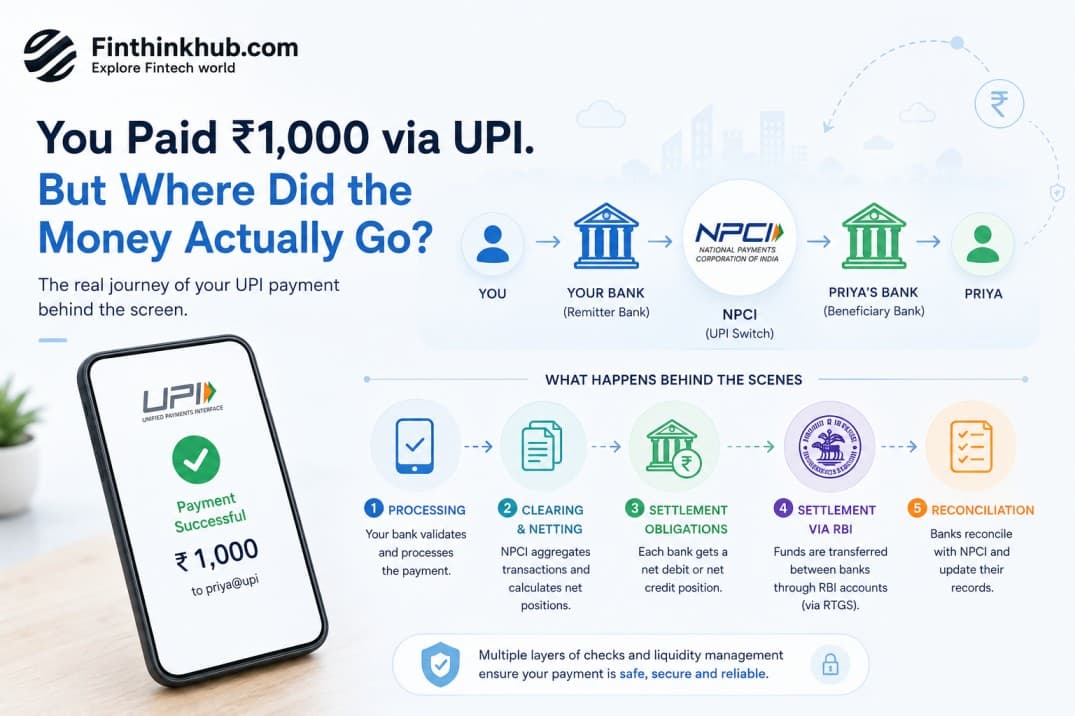
You send ₹1,000 to Tarun who is your colleague in Noida on UPI. Your phone buzzes, the app shows a green tick, "Payment Successful," and you get on with your day. Two seconds or maybe less.
Here's a question worth asking: what actually happened in those two seconds?
Not the animation on your screen. The real thing. Money left your bank account and reached Tarun's account. Two banks that don't know each other agreed a transfer happened and updated their books. That doesn't really happen in two seconds. What you see and what actually happens are two different processes, and the gap between them is what this piece is about.
What You See, And What You Don't
From where you're sitting, a UPI payment is simple. Open the app, enter Tarun's UPI ID or scan a QR code, type your PIN, done. The tick appears and you move on.
What you don't see: your bank checking that you actually have ₹1,000. Tarun's bank being told in a format it trusts, that money is genuinely coming. Both banks updating their ledgers. And, at some point not necessarily in that same two seconds, actual money moving between your bank and Tarun's bank at the level where banks keep funds with each other in their accounts with the Reserve Bank of India.
UPI's real trick isn't moving money instantly. It's making the part you see feel instant, while a slower, more careful process catches up later.
Who's Actually Involved
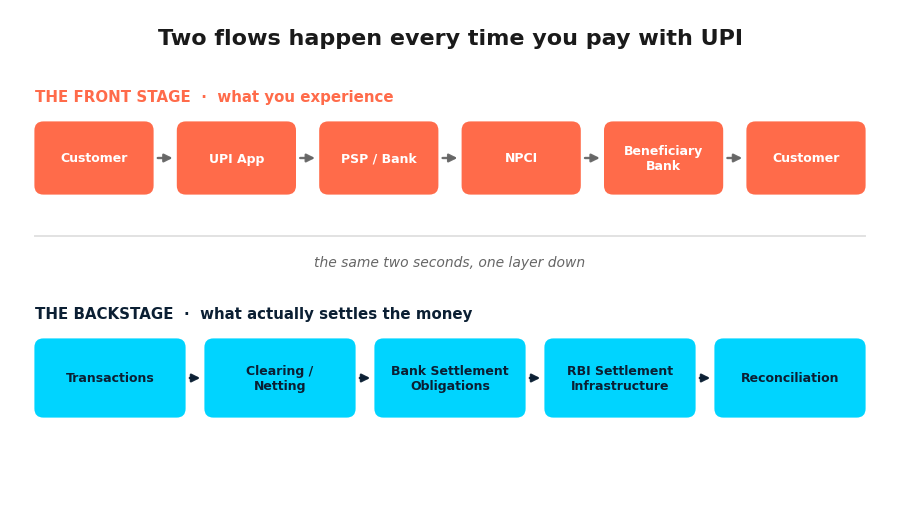
A UPI payment isn't a conversation between you and Tarun. It runs through five parties, each doing one job.
The UPI app (also known as TPAP) on your phone, PhonePe, Google Pay, Paytm, or your bank's own app, is just the interface. It never touches your money. The PSP, a bank that plugs the app into UPI's network and handles the real banking connection and authenticates the request. The remitter bank is where your money sits and gets debited. The beneficiary bank is Tarun's bank, where the credit lands. And NPCI - the National Payments Corporation of India that runs the switch that routes every message and keeps score of who owes whom.
PhonePe or Google Pay never appears in that list as a money mover. They're storefronts. The actual banking happens one layer behind them. That's worth remembering the next time an app has an "outage." What usually broke is the app, not the money.
Tap, Route, Debit, Credit
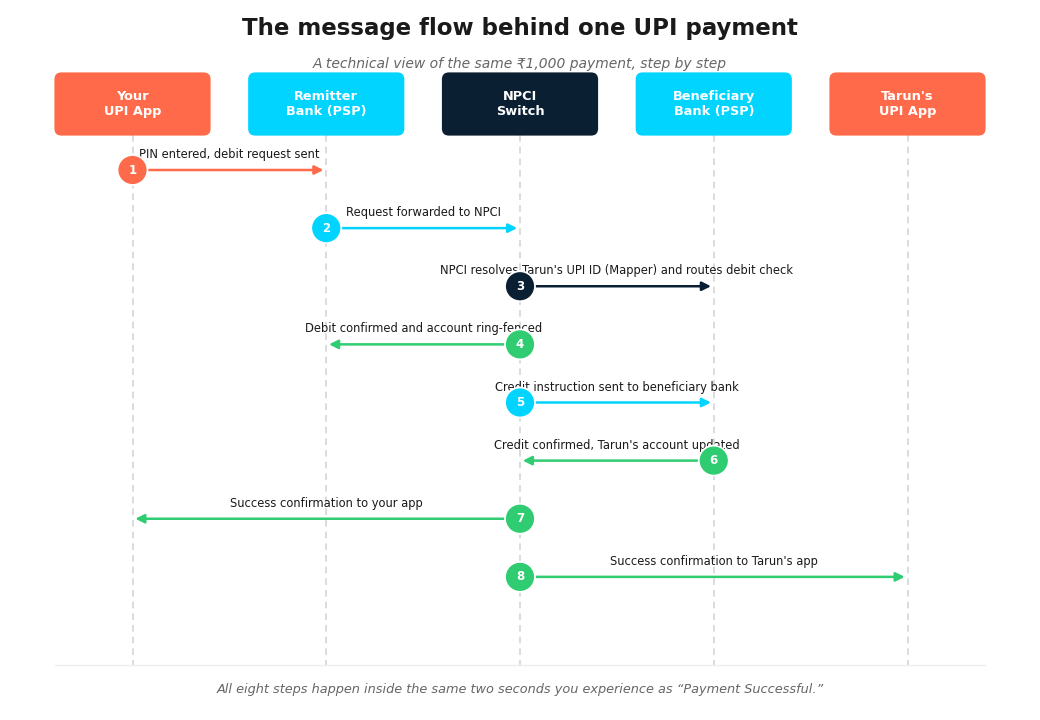
You enter your PIN, which authenticates you to your bank. Your app packages the request that your account name i.e.Tarun's UPI ID, the ₹1,000 amount and sends it to your PSP, which forwards it to NPCI.
NPCI's switch looks up Tarun's UPI ID to find his bank account, then routes the debit request to your bank and the credit instruction to his. Your bank checks your balance and confirms the debit. Tarun's bank accepts the credit. Both confirmations flow back through NPCI, and that's the moment you see the tick.
Here's the same payment again, drawn the way an engineer would draw it: eight numbered messages passing between five parties in that same two seconds.
If you notice missing part is actual cash moving between the banks' accounts at RBI. What moved was a set of verified instructions, not money itself. That distinction is the one thing worth really understanding.
Processing is what happens in your two seconds: instructions checked and applied to both banks' ledgers. Clearing is NPCI gathering every processed transaction and working out who owes what. Settlement is the actual transfer of money between banks through their RBI accounts. Your bank telling NPCI "we owe ₹1,000 for this transfer" is an instruction. RBI moving real money from one bank's account to the other is the settlement. Everything before that is bookkeeping but not yet money changing hands.
How NPCI Turns Crores of Payments Into One Number
If NPCI settled every UPI transaction one by one, the system would drown in its own volume. India did 2,366 crore UPI transactions in July 2026 alone. So NPCI doesn't settle them individually. It nets them.
Say in one settlement window, Bank A's customers send Bank B's customers a combined ₹212 crore across thousands of payments, your ₹1,000 to Tarun being one of them. In the same window, Bank B's customers send Bank A's customers ₹167 crore the other way. Instead of moving both amounts, NPCI works out the one number that matters: Bank A owes Bank B ₹45 crore as net. That's the only amount that has to physically move.
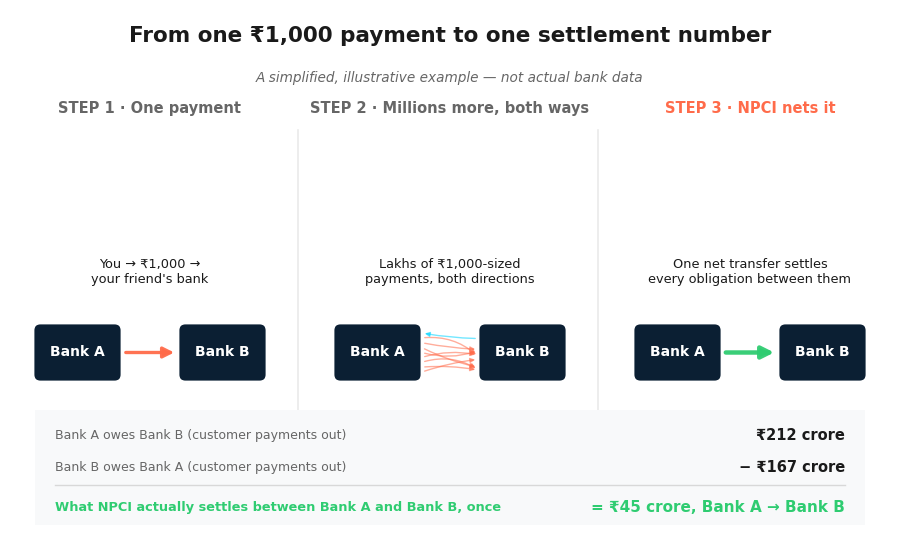
Now scale that up. NPCI does this across all 703 banks live on UPI, several times a day. Each bank ends up in a net debit position (it owes more than it's owed) or a net credit position (it's owed more than it owes). Only that single number per bank gets settled, not the millions of ₹1,000 payments underneath it.
Where RBI Actually Sits
This is worth being clear about: RBI is not approving your ₹1,000 payment to Tarun. It never sees that transaction as a single event.
RBI's role is structural. Under the Payment and Settlement Systems Act -2007, no one can run a payment system in India without RBI's authorisation and NPCI operates UPI under exactly that authorisation. RBI also holds the actual settlement rails. Every bank keeps a current account with RBI and final settlement, the real movement of NPCI's net numbers, happens through RBI's (RTGS) Real Time Gross Settlement system running 24x7 since December 2020.
RBI acts more like the country's central clearing bank and rule-setter than a gatekeeper checking individual payments. It authorises NPCI that holds the accounts that make settlement possible and steps in if something threatens the whole system.
The Money Banks Keep Ready
Netting raises one question: what if Bank A doesn't have ₹45 crore free at the moment of settlement? NPCI's answer is the Settlement Guarantee Fund. Every bank on UPI contributes to it, partly in cash, mostly through a line of credit arranged among the banks themselves plus government securities as collateral. If a bank can't pay on time, the fund covers the gap immediately so the other side still gets paid. A temporary shortfall gets repaid later. A genuine default gets shared among the remaining member banks.
That's why you've probably never worried about whether Tarun's bank can actually pay when you send him ₹1,000. Banks manage their liquidity carefully through the day, and the fund exists for the rare moment that isn't enough.
Why It Feels Instant When Settlement Isn't
When Tarun's phone shows the money credited, has settlement between the two banks actually happened? Usually not yet. Both banks have updated their ledgers based on instructions they trust completely, ahead of the settlement cycle that follows later that day. UPI runs through 10 settlement cycles daily for regular payments, plus two more for dispute cases, a structure NPCI put in place in November 2025.
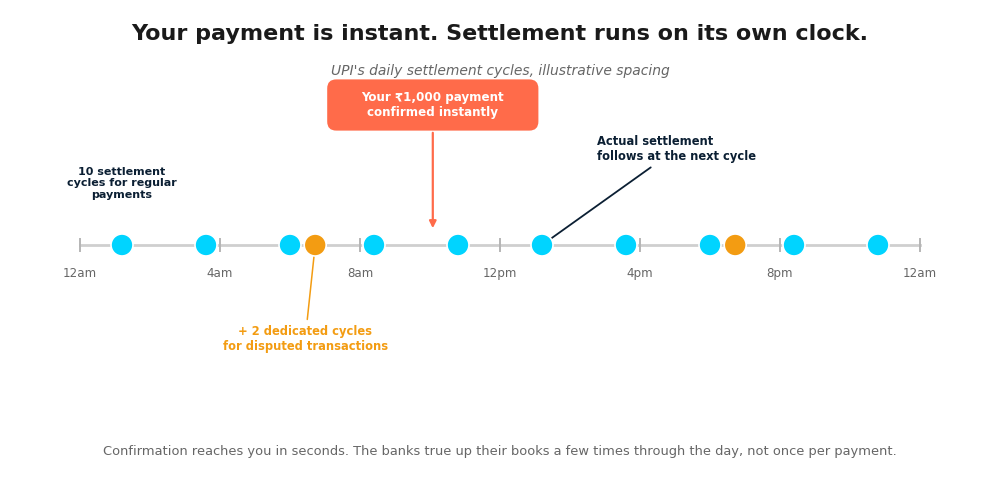
Think of a group trip where everyone notes who owes what after each meal, but nobody transfers money until the end, when it's settled in a couple of payments instead of twenty. Your UPI payment landing in two seconds is the "everyone agrees and writes it down" part. The settlement cycle is the actual transfer at the end.
When ₹1,000 Doesn't Land
If your money gets debited but never credited to Tarun, NPCI and the banks run a reconciliation process comparing each bank's ledger against NPCI's records. Most mismatches are auto-reversed without you doing anything. RBI's rules require failed transactions to be reversed within a set deadline, and if a bank misses it, it owes you ₹100 for every day of delay.
A genuine dispute, say money reaching the wrong ID, goes through NPCI's dispute resolution system, with set timelines for both banks to respond. You usually just see a refund land back in your account within a day. That's the real answer to whether your money is safe on UPI: a working reconciliation layer, not a marketing line.
UPI Isn't an App. It's Infrastructure.
Look at everything behind one ₹1,000 payment: an app that never touches money, a PSP that authenticates you, a switch that routes and matches, a clearing process that nets your payment against millions of others, a settlement layer that moves real money through RBI's books, and a guarantee fund and reconciliation system standing by in case anything slips.
That's not a payments app. That's national financial infrastructure with a good app on top of it. UPI crossed 24,162 crore transactions worth roughly ₹314 lakh crore in FY2025-26, ten years after launch, and the IMF has called it the world's largest real time payment system by volume. None of that runs on good design alone.
So the next time your phone buzzes with "Payment Successful," you'll know what that tick is really promising. Not that the money already moved, but that your bank, Tarun's bank, NPCI, and RBI's settlement rails just quietly agreed it's going to. Two seconds on your screen. A whole country's banking system underneath it, doing exactly what it was built to do.
Reference:
NPCI Settlement Risk Management (Settlement Guarantee Fund structure); NPCI circular on segregation of UPI settlement cycles, effective November 3, 2025 (via Complinity)
RBI "Payment and Settlement Systems" overview and Payment and Settlement Systems Act, 2007 (rbi.org.in)
RBI RTGS 24x7 operations since December 2020; Business Standard, "UPI clocks record monthly volume as July transactions rise 4.1% to 23.66 bn," August 2026; Business Today, "10 years of UPI: Transaction value surges 4,000-fold to reach ₹314 lakh crore," August 2026
RBI framework on Harmonisation of Turn Around Time and customer compensation for failed transactions; Paytm Editorial, "Roles and Responsibilities of NPCI, PSP, and TPAP in UPI."
Responses (0)
Leave a response
Related Articles
GuideFin: A Real Plan Not Just Another Investment App
Why the middle class Indian investor doesn't need another place to invest. They need a clear plan, and an honest way to …

How Invoice Discounting Apps Are Growing in India
Most Indians learn investing in the same order: 1st savings account, then FD, then mutual funds and SIPs, then maybe NPS…
Beyond UPI: How Fintechs Are Turning Payments into Wealth and Lending Platforms
India's fintech story started with a basic need. People wanted to send money quickly and cheaply and, UPI solved that. O…