How ML Models Are Replacing FICO/CIBIL Scores in Credit Underwriting
How ML Models Are Replacing FICO/CIBIL Scores in Credit Underwriting Credit scoring has worked the same way for decades. Just look at your past borrowing, count how…
How ML Models Are Replacing FICO/CIBIL/Experian Scores in Credit Underwriting
Credit scoring has worked the same way for decades. Just look at your past borrowing, count how reliably you repaid, assign a number. Simple, auditable and deeply flawed. Machine learning is now rewriting the rules and nowhere is the shift more consequential than in India.
The FICO/CIBIL Problem
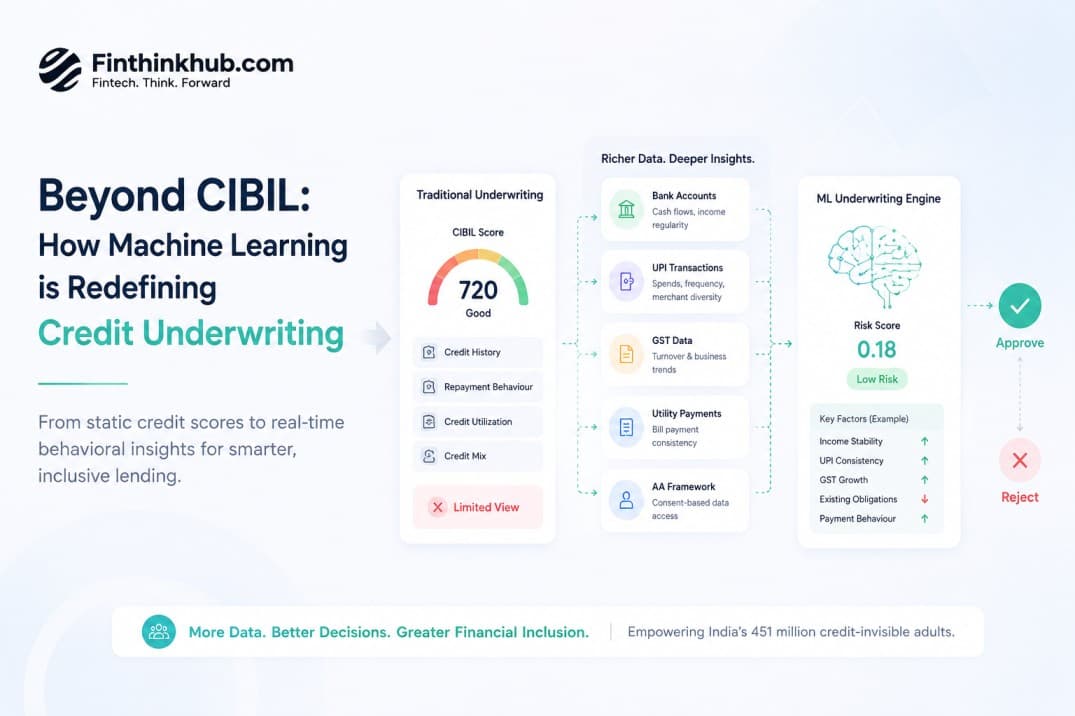
FICO (used globally) and CIBIL TransUnion (India) share the same core limitation: they only score people who already have credit history. FICO requires a minimum of six months of credit history to generate a score at all. In India, where only 27% of the ~1 billion credit-eligible adults actively use formal credit facilities, this leaves roughly large million people effectively un-scorable not because they're risky, but because they've never had a chance to prove otherwise.
Traditional models also rely on a narrow feature set: loan repayment history, credit utilization, account age, and credit mix. They're static. A salaried professional who lost a job and recovered two years ago looks identical to one still struggling today. The model doesn't know the difference.
What ML Models Do Differently
ML-based underwriting isn't just about using more data it's about using alternative data and updating predictions in near real time.
Feature Expansion
Deep neural networks can process hundreds to thousands of features simultaneously. These include:
Bank statement cash flows — income regularity, salary-day spikes, recurring expenses
UPI transaction patterns — frequency, merchant diversity, bill payment consistency
GST filing data — for MSME borrowers, turnover trends tell more than a credit score
Telecom and utility payments — proxy signals for financial discipline
Device and app behavior — session depth, time of application, app usage patterns (used carefully and with consent)
The result: a dynamic, individual-level risk profile vs. a static group-level score.
Performance Gap
Indian fintech lenders using ML models report 25–40% lower default rates and 15–20% higher approval rates compared to traditional scorecard approaches, according to industry analysis. Globally, ML-enhanced models show 15–25% better default prediction accuracy over FICO-only rules, per Neontri's 2026 implementation analysis.
India's Structural Advantage: The UPI Data Layer
India has an asset no other market has at scale — a public payments rail generating behavioral data on over a billion users.
UPI processed billion transactions per month in 2024, according to CARD91's analysis of UPI behavioral scoring. Every transaction — grocery payment, utility bill, peer transfer is a timestamped signal of financial behavior. For a "new-to-credit" customer with no CIBIL score, 12 months of UPI history can substitute for years of formal credit data.
The Account Aggregator (AA) framework, launched by RBI takes this further. It lets lenders with user consent pull structured financial data (bank statements, mutual fund holdings, GST returns) across institutions via a standardized API stack. Platforms like Perfios, FinBox, and CRIF are already building ML underwriting pipelines on top of this infrastructure.
The combination of UPI + AA + Bureau data enables what the industry now calls contextual underwriting — lending decisions shaped by real, current financial behavior rather than historical credit proxies.
Who's Doing It
Lendingkart uses ML across 1,300+ variables to underwrite MSME loans, reaching businesses that traditional banks reject outright.
Tala, operating across Kenya, the Philippines, and Mexico, uses mobile metadata and transaction patterns to score thin-file borrowers. Borrowers on the platform saw average household income rise 20.8% and employment increase 23.5% compared to control groups, per research cited by TrustDecision.
Globally, Ping An (China) runs ML-driven underwriting that processes 93% of new insurance policies within seconds across 220 million customers — a benchmark for what scaled ML decisioning looks like in financial services.
The Hard Part: Explainability
There's a real tension between accuracy and explainability. A random forest model might outperform a logistic regression by 20%, but it can't easily tell a rejected applicant why they were turned down — which is both a regulatory requirement and an ethical one.
India's RBI and global regulators increasingly expect Explainable AI (XAI) model outputs that can be interpreted, audited, and defended. SHAP (SHapley Additive exPlanations) values and LIME (Local Interpretable Model-agnostic Explanations) are now standard tools used to generate feature-level explanations for individual decisions, bridging the gap between accuracy and transparency.
Traditional Model
Credit Score: 720
Income: ₹10L
Decision: Approve
ML Underwriting
Credit Score: 720
UPI Consistency: High
Salary Stability: High
Utility Payments: Consistent
GST Growth: +18%
Decision: Approve
Confidence: 92%
Where This Is Heading
The CIBIL score isn't going away tomorrow. Banks still rely on it for regulatory compliance and legacy system compatibility. But the direction is clear: ML-based models are becoming the primary decisioning layer, with bureau scores as one input among many — not the final word.
The next evolution is agentic underwriting where AI not only scores risk but continuously monitors borrower behavior, adjusts limits dynamically, and proactively intervenes before defaults occur
References
Responses (0)
Leave a response
Related Articles

P2P Lending in India: The Risk Behind the 12% Return
Remember the "12% returns" tab inside Cred, BharatPe or MobiKwik apps some years back? Put money in, take it out wheneve…
ULI vs OCEN: Why RBI Built a New Lending Platform When One Was Already There?
India has a interesting problem right now. We have not one but two digital systems trying to fix the same thing i.e. get…

How India's Economy Works: Applying Ray Dalio's Economic Machine Framework
There's a 30 minute animated video on YouTube. No celebrity drama, Just a man named Ray Dalio sitting down and explainin…